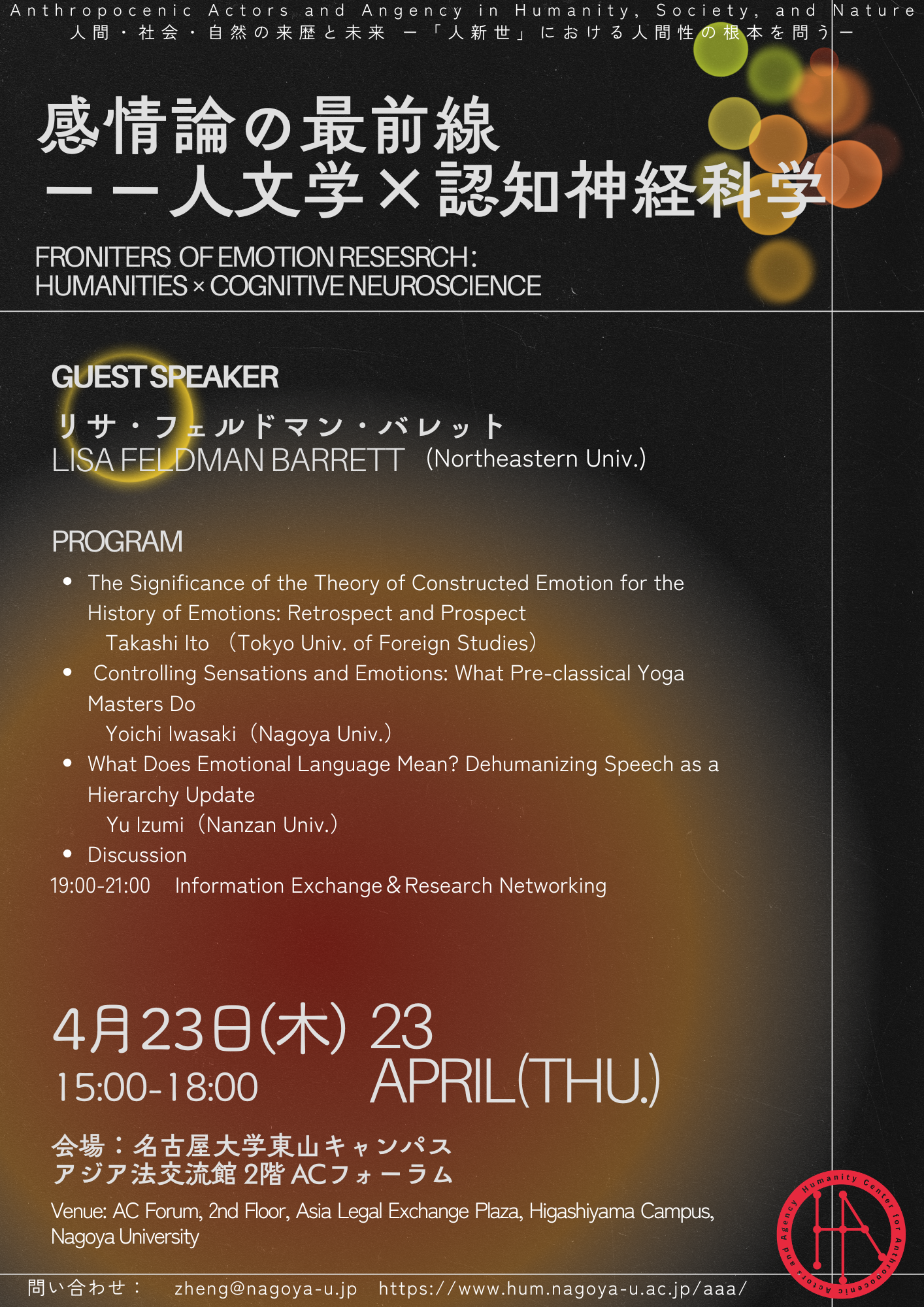
This workshop was held to examine emotion research from the perspectives of both the humanities and cognitive neuroscience. With Lisa Feldman Barrett’s Theory of Constructed Emotion as its central framework, the event aimed to connect the fields of the history of emotions, Indian philosophy/Yoga thought, and linguistic philosophy/semantics.
At the beginning, Yasuko Nakamura explained the aims of the AAA Project. The constructionist understanding of emotion was positioned as being closely related to the project’s core interest: the process of relationship formation between subjects and their environments.
Subsequently, Hideki Ohira introduced Barrett’s research achievements. He noted that she is an internationally renowned researcher in psychology and neuroscience, primarily focused on emotion research, with over 300 papers published in major academic journals such as Nature, Science, and Nature Reviews Neuroscience.
🌟Takashi Ito (Tokyo University of Foreign Studies): “The Significance of the Theory of Constructed Emotion for the History of Emotions: Retrospect and Prospect”
He raised the question of whether past emotional experiences should be understood using modern emotional categories. Using Basho’s haiku and Hamlet’s soliloquies as examples, he questioned whether what we read today as “loneliness,” “sadness,” or “alienation” were emotions experienced in the same way by people in the past, or if they are projections of modern concepts. He then summarized the limitations of essentialism (viewing emotions as universal biological reactions) and social constructionism (viewing emotions as historically and culturally constructed), presenting Barrett’s Theory of Constructed Emotion as a framework to bridge the two. A particularly important point is that while emotions have physical and biological foundations, emotional categories like “loneliness” or “anger” are constructed by language, culture, historical context, and conceptual repertoires.
Barrett’s Response: She highly praised Ito’s presentation and expressed her support for the significance of connecting the Theory of Constructed Emotion to the history of emotions. It was confirmed that emotions should not be captured only through the dichotomy of essentialism versus social constructionism, but rather by considering both biological foundations and the formation of historical/cultural categories. Furthermore, regarding Darwin’s theory of emotion, a discussion was held on the danger of modern psychology reinterpreting historical texts according to current theoretical frameworks, and the importance of reading in a way that respects the historical context was shared.
🌟Yoichi Iwasaki (Nagoya University): “Controlling Sensations and Emotions: What Pre-classical Yoga Masters Do”
He examined the question of whether it is possible to stop the tendency to seek pleasure and avoid suffering from the perspective of pre-classical Yoga thought. His presentation showed the chain of mind and action—perception, desire/aversion, will, and action—and argued that the point of intervention should not be the action itself, but the stage where perception generates desire or aversion. In the Bhagavad Gita, rather than directly controlling grief or despair, importance is placed on weakening the binary evaluations that cause them, such as success/failure, gain/loss, and pleasure/pain. This attitude is called “equanimity” (non-discriminatory attitude). He concluded that by repeating the practice of acting without desire and without attachment to results, the emotional reaction to sensory objects itself can gradually transform.
Barrett’s Response: Focusing on the empiricist aspect of pre-classical Yoga, she stated that emotions and pain should be understood not just through a linear “stimulus → sensation → evaluation → action” model, but as a process of prediction, categorization, and action planning based on past experiences. Discussions on chronic pain and mindfulness meditation also took place, showing that by not viewing pain as a monolithic “suffering” but by reconstructing it into higher-granularity categories, the experience itself could potentially be transformed.
🌟Yu Izumi (Nanzan University): “What Does Emotional Language Mean? Dehumanizing Speech as Hierarchy Update”
He pointed out that emotional language expressions do not just express feelings but function to update social relationships and hierarchies. He addressed insults, interjections, profanity, honorifics, anti-honorifics, and dehumanizing expressions, explaining that these are not evaluated by truth or falsehood like typical descriptive sentences, but rather carry conditional meanings related to the speaker’s attitude and the context of the utterance. In particular, honorifics position the other person as socially superior, while anti-honorifics and insults position them as inferior. Furthermore, it has also been argued that dehumanizing expressions that use animal names go beyond mere insults; by positioning the subject as a “being inferior to humans,” they serve to linguistically reinforce social and ontological hierarchies.
Barrett’s Response: She raised the fundamental question, “What makes that expression emotional language?” In response, Izumi explained that the category of emotional language does not exist as an explicit label within natural language; rather, he analyzes, from semantic and pragmatic perspectives, a group of expressions that speakers intuitively perceive as emotionally or expressively loaded. Through the discussion, it was confirmed that emotional language functions not only to express the speaker’s feelings but also to manipulate social distance, hierarchies, intimacy, contempt, and exclusion with the listener.
General Discussion and Barrett’s Closing Comments
In the general discussion, the possibility of connecting humanistic and cognitive neuroscientific research on emotion was examined through the three presentations. Barrett emphasized the importance of cross-disciplinary dialogue in response to each talk. Specifically, it was stated that when studying emotion, it is essential to incorporate conceptual and methodological questions presented by history, philosophy, religious studies, and linguistics, in addition to psychology and neuroscience. The understanding shared throughout the workshop was that emotion is neither a fixed reaction in the brain nor a mere cultural discourse, but a constructed phenomenon in which bodily states, concepts, language, history, and social relationships interact.
(Authorship: Wanwan Zheng, Humanity Center for Anthropocenic Actors and Agency, Graduate School of Humanities, Nagoya University)