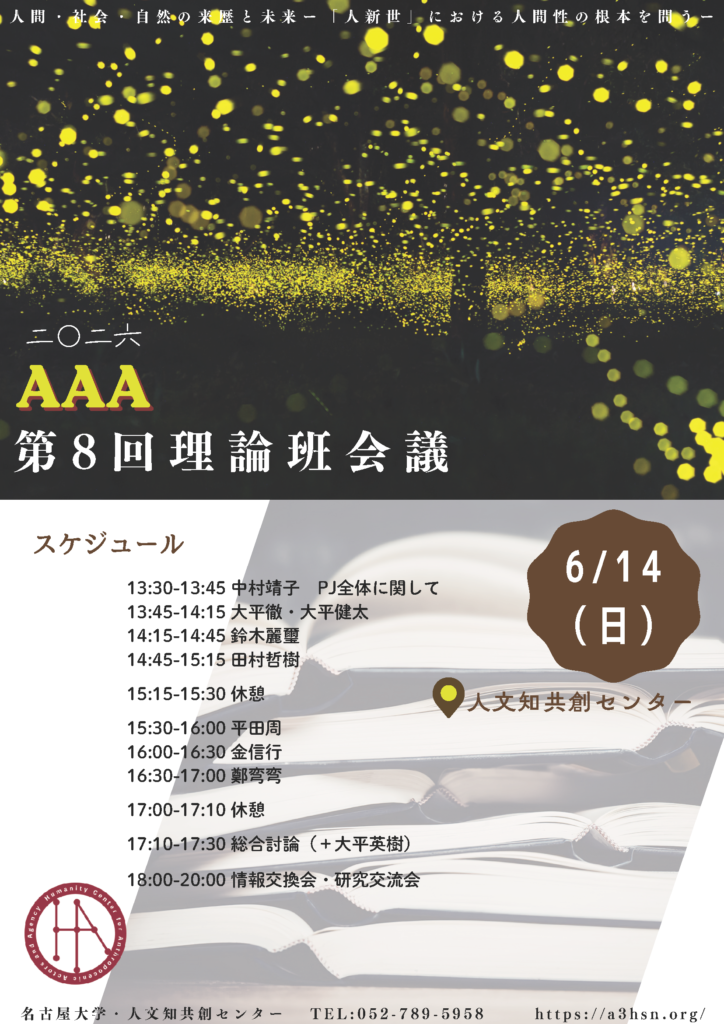
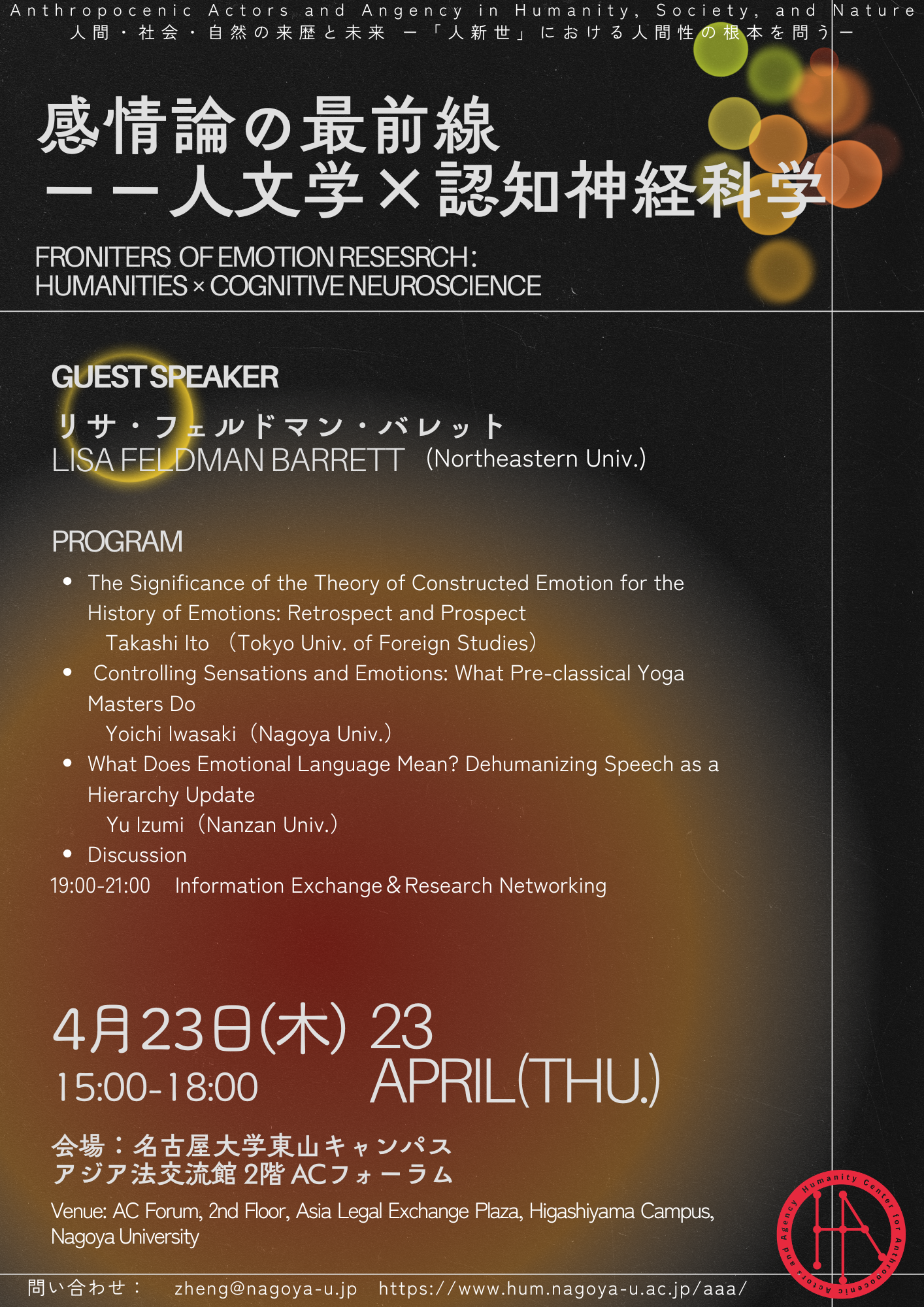
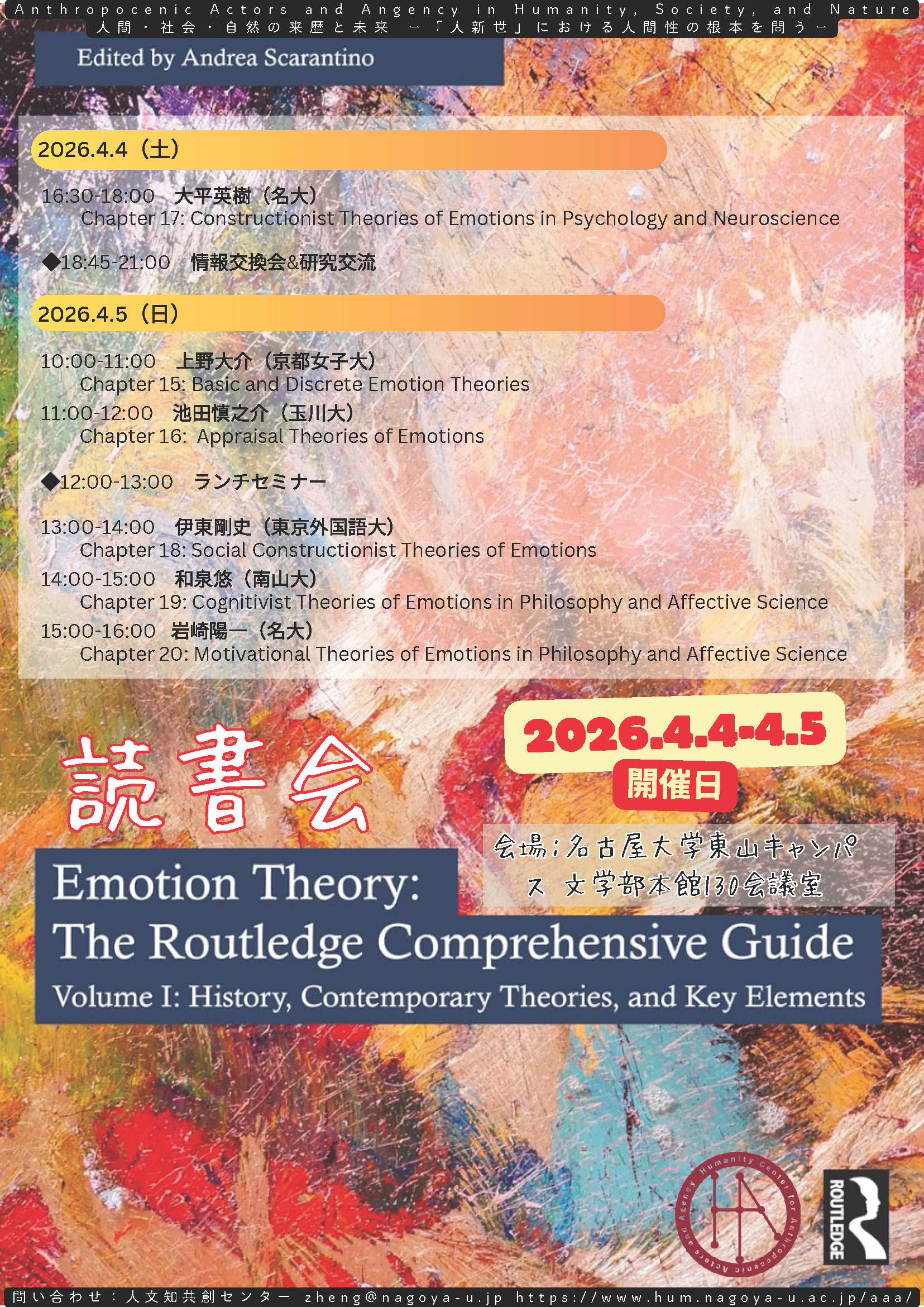
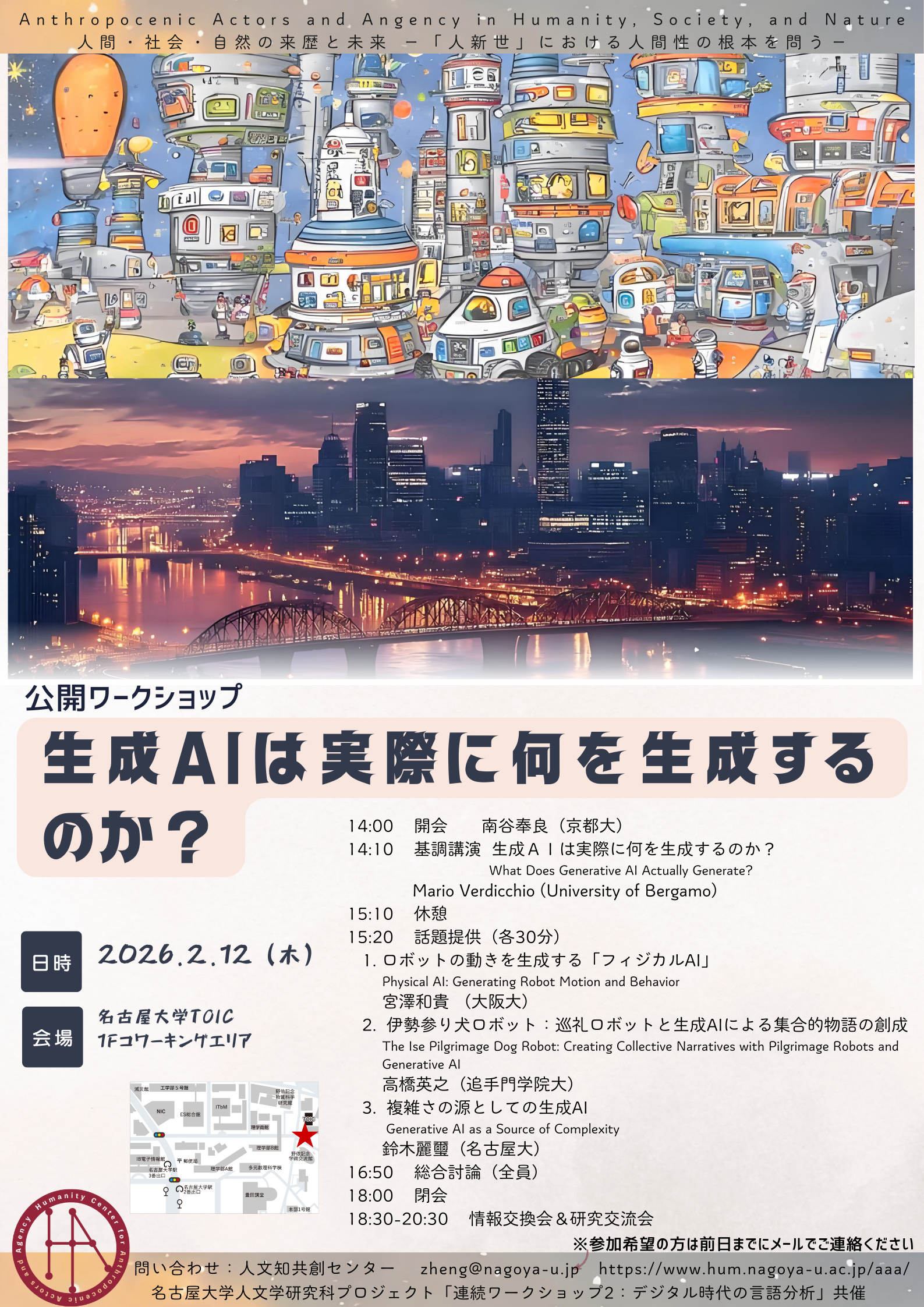
Following the reorganization of Group 5 this fiscal year, a group meeting was held at the Humanities Center for Anthropocenic Actors and Agency to reaffirm the project’s overall framework and the roles of each research group, share each member’s research, and discuss the direction for the final year of the project as well as plans for Group 5 activities.
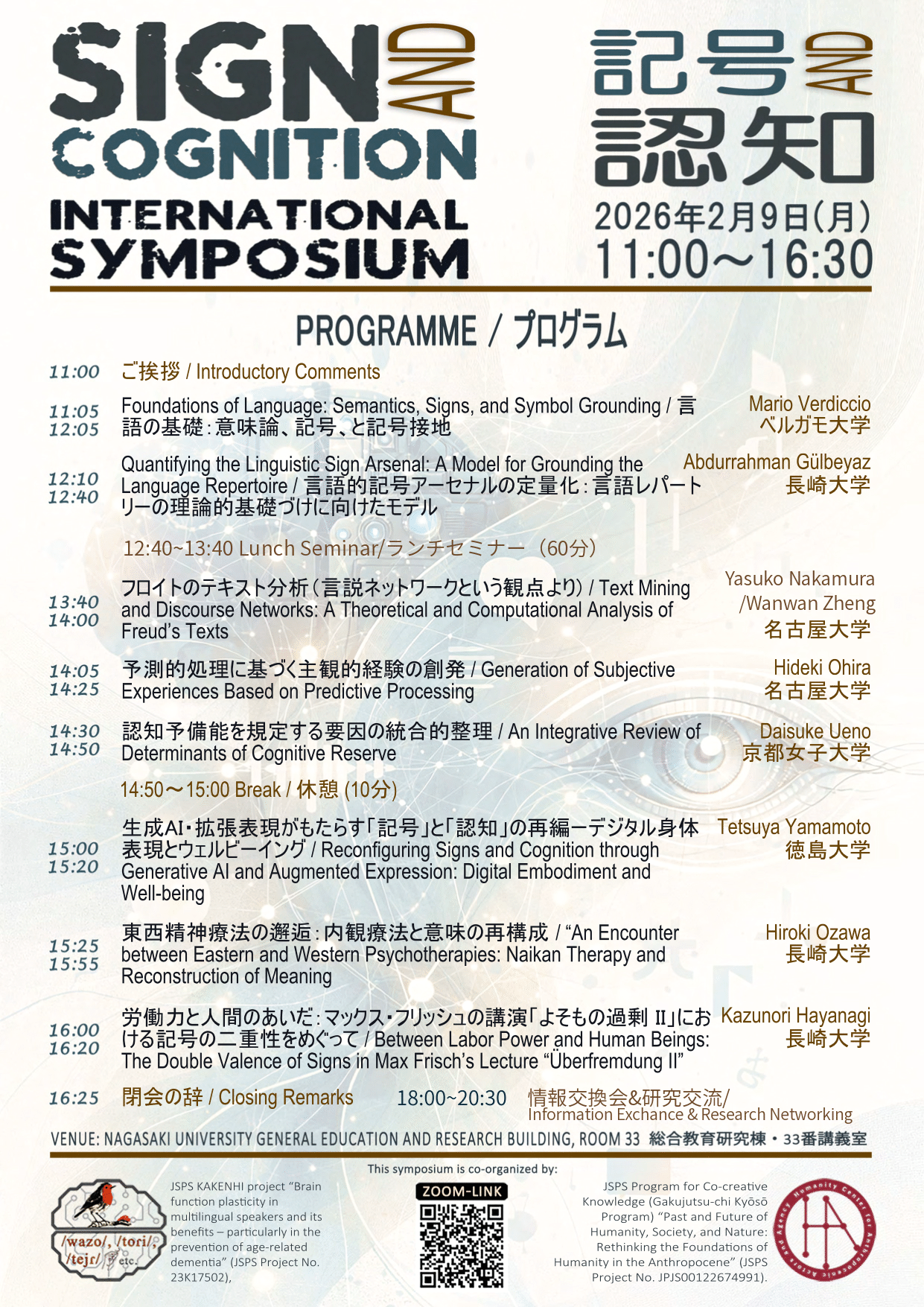
Yasuko Nakamura (German Literature and Intellectual History) — “Techniques for Making the Human / The Imagination that Dismantles the Human: The Formation and Transformation of Habitus, and the Co-evolution of Language and Machines”
As a starting point for her research in this project, Nakamura took up Roberto Esposito’s proposition that “human nature is already non-natural.” Proceeding from the premise that human beings are not naturally given but are continuously formed through language, the body, desire, institutions, and technology, she revisited Pierre Bourdieu’s theory of habitus, emphasizing that practices and representations arise not from obedience to explicit rules but from embodied dispositions. She further examined language as a medium that generates, shares, and transforms meaning, and, drawing on Kittler’s concept of discourse networks and Sloterdijk’s theory of anthropotechnik, explored Sloterdijk’s thesis that “humans produce humans.”
Ayako Ikeno (Contemporary Italian Art)
Ikeno reported on her research in the history of Western art, with a particular focus on the relationship between Italian art and politics in the first half of the twentieth century. She introduced her work on the relationship between humans and machines in Italian Futurism, on Arte Povera, which emerged in Italy in the late 1960s, and on representations of breath and air. In considering the relationship between art and politics, she highlighted concepts such as the air surrounding the body, the atmosphere, breath, membranes, and interfaces as key points of discussion. The subsequent discussion touched on Seiko Mikami’s concept of membrane sculpture, the shift from an autoimmune-disease model to the concept of interface, and the possibility of understanding the atmosphere as a vast membrane. Ikeno’s presentation connects the study of twentieth-century Italian art with the project’s broader concerns with life, technology, politics, and the environment, and it was confirmed that discussion of breath, air, and membranes will be further developed toward the general research meeting in August.
Tetsuya Yamamoto (Clinical Psychological Informatics)
Yamamoto reported on research into mental health support using AI, VR, wearable devices, and digital tools, approached from the standpoint of clinical psychology and clinical psychological informatics. The presentation introduced efforts to analyze complex health data through AI and machine learning, including the prevention of depression and the analysis of relapse risk, recidivism prevention for sex offenders, and the prediction of headaches and well-being. Yamamoto explained that negative thinking patterns and activity levels influence the risk of depression relapse, and that cognitive behavioral therapy can be understood as a method of intervening in these variables; he further suggested the potential for AI to contribute to the application of psychotherapy and psychoeducation.
Yamamoto’s presentation also introduced a range of research spanning clinical psychology and information technology, including AI-generated imagery, VR-based psychotherapy, psychoeducation using AI agents, and exhibition-based demonstration projects for children. In particular, he shared several ongoing empirical initiatives: the development of an AI agent that children can interact with at science museums in Tokushima and elsewhere, a light-based biofeedback demonstration experiment at Takanawa Gateway, and the introduction of an AI agent into the obesity clinic at Kansai Medical University. He also noted that while the large-scale version of the AI agent is difficult to transport, a compact version of about 60 centimeters can be brought to research meetings for demonstration. The subsequent discussion addressed how AI agents and robots might engage with human emotion, embodiment, interpersonal relationships, and the resolution of social issues.
Hideki Ohira (Psychology and Cognitive Neuroscience)
Ohira presented under the title “Embodied Habitus: From Esposito’s Theory of Immunity and Predictive Processing.” The presentation began by confirming Bourdieu’s concept of habitus as the dispositions of thought, behavior, and taste acquired through socialization, showing the need to extend this concept beyond the brain to the entire body. Drawing on Esposito’s discussion of community and immunity, Ohira explained that while community has been understood as a group sharing common obligations, immunity has been understood as a function that either exempts one from those obligations or excludes foreign elements. He further noted that the concept of immunity originally belonged to the legal and political domain, and that in the modern period it was repurposed within biomedicine into a bodily conception of “immunity as defense.”
The core of the presentation was a perspective that reconceives the immune system not merely as a device for distinguishing self from non-self, but as an allostatic system that predictively allocates bodily resources based on environmental change, the contingency between behavior and outcome, and reward prediction error. Ohira introduced research on fluctuations in immune cells under acute stress, NK cell responses, simultaneous measurement of brain activity and physiological responses, and the updating of bodily states through reward prediction error, showing how social experience organizes cardiovascular, endocrine, and immune responses via the brain’s predictive models. The presentation concluded by suggesting that social experience is organized as habitus through predictive processing in the brain and body; that the immune system dynamically regulates a continuum between tolerance/acceptance and rejection/exclusion; and that the immune system’s characteristic of habituating to repetitive, sustained stimuli while responding to abrupt change or discontinuity may itself be implicated in how an embodied habitus behaves in relation to the social environment.
Fuminori Akiba (Aesthetics)
Akiba reported on the institutionalization of aesthetics, its connections with information science, and the possibilities for collaboration between the arts and the natural sciences. The discussion addressed how aesthetics has historically been institutionalized, and how contemporary art research might collaborate with the natural sciences, information science, environmental studies, and technology studies. Akiba’s presentation pointed toward an approach that treats art not as an object enclosed within the humanities, but as something to be reconsidered in relation to science and technology, institutions, the environment, and social practice. This proved an important point for Group 5’s guiding theme of “biopolitics and art”—that is, for thinking through the relationship between the institutions and technologies that manage life and the artistic practices that resist or transform them.
Masumi Kameda (Soviet Culture and Literature)
Kameda reported on her research covering Slavic studies, Soviet culture and literature, propaganda, the concept of empathy, and the cultural and political relationship between the Soviet Union and the United States. The presentation introduced the problem of socialism versus communism in Soviet studies, new approaches to propaganda research, and her reasons for choosing Croatia as a field site. The discussion took up comparisons between the camp experiences of Soviet prisoners and of Jewish victims, questions of colonialism, necropolitics, the politicization of victimhood, and issues of memory and political legitimation since the latter half of the twentieth century.
In connection with Kameda’s presentation, participants also discussed the possibility of inviting Achille Mbembe in December, as well as questions raised by Hirata concerning Mbembe and Fanon. In particular, themes such as violence, camps, colonialism, victimhood, and political division emerged as key reference points for Group 5’s research on biopolitics. Kameda’s presentation connected the study of Soviet culture and literature to broader questions of political violence, memory, community, immunity, and exclusion in the modern period and beyond.
Miki Okubo (Aesthetics, Semiotics, and Ecology) — Okubo reported on her research and practice concerning aesthetics, semiotics, ecology, and the relationship between technology and life. The presentation introduced exhibitions and artistic practices addressing ecology and technology, subjectivity, life, and the environment, and discussed how the relationship between technology and life might be understood, as well as how contemporary art can challenge anthropocentrism. Referring to projects and exhibitions such as “Metamorphosis” and “Teaching Stones to Talk,” she focused on themes including transformation, the body, care, the environment, and technology.
The subsequent discussion brought together concepts such as ecological art, Latour’s curatorial practice, critical zones, breath, air, and membranes. In particular, participants shared a perspective that understands the human being not as an independent subject but in relation to environment, technology, others, and living processes. At the general research meeting in August, Shu Hirata and Shinhaeng Kim are scheduled to comment on Okubo’s presentation, and the discussion is expected to develop across aesthetics, urban theory, actor-network theory, and ecology.
Mika Kan (Artistic Practice and Study of Culture and Representation)
Kan introduced her creative work, focusing on photographic and video works using dolls. The presentation explored how artistic practices involving dolls and figures engage with issues of the body, gender, desire, the gaze, the boundary between the living and the non-living, and the body as artifact. Kan’s work calls into question humanity, embodiment, artificiality, and the boundaries of life. At the general research meeting in August, Hideyuki Takahashi and Tetsuya Yamamoto are scheduled to comment on Kan’s presentation, and the discussion is expected to develop across robotics, clinical psychological informatics, and artistic practice, with particular attention to dolls, AI agents, robots, and body image.
Tetsuya Yamamoto (Clinical Psychological Informatics)
In the latter half of the session, Yamamoto commented on Kan’s doll-based artworks and Okubo’s discussion of technology and life, drawing on his own research combining clinical psychology and AI. He suggested that AI agents should be understood not merely as information-processing systems but as mediators of human embodiment, emotion, interpersonal relationships, and social practices.
Hideyuki Takahashi (Robotics)
Takahashi examined the roles that robots can play in relation to humans by comparing coexistent robots with therapeutic robots. Whereas coexistent robots are positioned as tools that support the acquisition of knowledge and skills, therapeutic robots and conversational AI agents are involved in emotional relationships, a sense of security, and practices of care. He further discussed how robots influence human emotions and social relationships. Although Yamamoto’s research on AI agents, Kan’s doll-based artworks, and Okubo’s discussion of technology and life belong to different fields, they share common themes, including the relationship between humans and artificial objects, the extension of embodiment, the performance of lifelikeness, and the technologization of care and healing.
Shu Hirata (Urban Studies)
Hirata confirmed his role as a commentator on Miki Okubo’s presentation. In the discussion, he addressed issues including Achille Mbembe, Frantz Fanon, colonialism, the experience of internment camps, breathing, and the planetary community, raising questions that connected biopolitics with urban studies, colonialism, and environmental theory. In particular, he argued that breathing is not only a vital bodily function but also a concept closely related to air, the atmosphere, the environment, political violence, and colonial domination. This perspective resonated with Ikeno’s research on breathing and air as well as Okubo’s discussion of ecology. Hirata’s comments expanded the Group 5 discussion beyond the body and artworks to urban space, colonialism, the global environment, and political violence.
Shinhaeng Kim (Actor–Network Theory)
Kim confirmed his role as a commentator on Miki Okubo’s presentation. Throughout the project, habitus theory and Actor–Network Theory (ANT) have served as the theoretical foundations for analyzing relationships among diverse actors—including humans, animals, objects, machines, and concepts. ANT is particularly important for examining the relationships among humans, society, and nature. Okubo’s discussion of ecology and technology, Ikeno’s work on membranes, air, and the atmosphere, Yamamoto’s research on AI agents, and Kan’s doll-based artworks all explore relationships not only among humans but also between humans and nonhuman actors. Kim’s comments are expected to connect these discussions to the project’s broader theoretical framework.
Tetsuya Yamamoto (Clinical Psychological Informatics)
Finally, Yamamoto returned to the technical implementation of AI agents and dolls, explaining the potential of using dialogue with AI to address social issues. While Kan’s doll-based artworks question human-like qualities, body images, and the emotional projection onto artificial objects, AI agents can contribute to behavioral change, psychological education, and practices of care through dialogue and feedback. From this perspective, Yamamoto pointed out the need to treat the discussion of dolls, robots, and AI agents not merely as a matter of technical implementation, but as a question of how humans form relationships with artificial objects, and how, through those relationships, self-understanding and social behavior change. Participants agreed to continue examining these issues at the general research meeting in August.
General Discussion
During the general discussion, multiple themes—including immunity, habitus, prediction error, embodiment, membranes, breathing, ecology, AI, robotics, and artistic practice—intersected. In particular, participants shared the perspective that immunity should not be understood as a simple boundary between self and non-self, but rather as a continuous and dynamic process of regulation. Furthermore, the possibility of considering the process by which social order and norms become embodied in connection with the predictive processing of the brain, body, and immune system was discussed. Additionally, through concepts such as breathing, air, membranes, the atmosphere, and critical zones, the discussion confirmed a direction for reconsidering the relationships among humans and the environment, the body and the external world, and art and politics.
Finally, in preparation for the general research meeting scheduled for August 25 and 26, the session structure, presenters, commentators, and time allocation for Group 5 were confirmed. In addition, the Group 5 session is scheduled for the morning of the 26th and will serve as an opportunity to confirm the connections between the group’s research as a whole and its future direction. An explanation was also provided regarding Volume 5 of the series, and it was confirmed that project members are expected to contribute to one of the volumes. It was decided that discussions within the group would continue while organizing each member’s research themes.