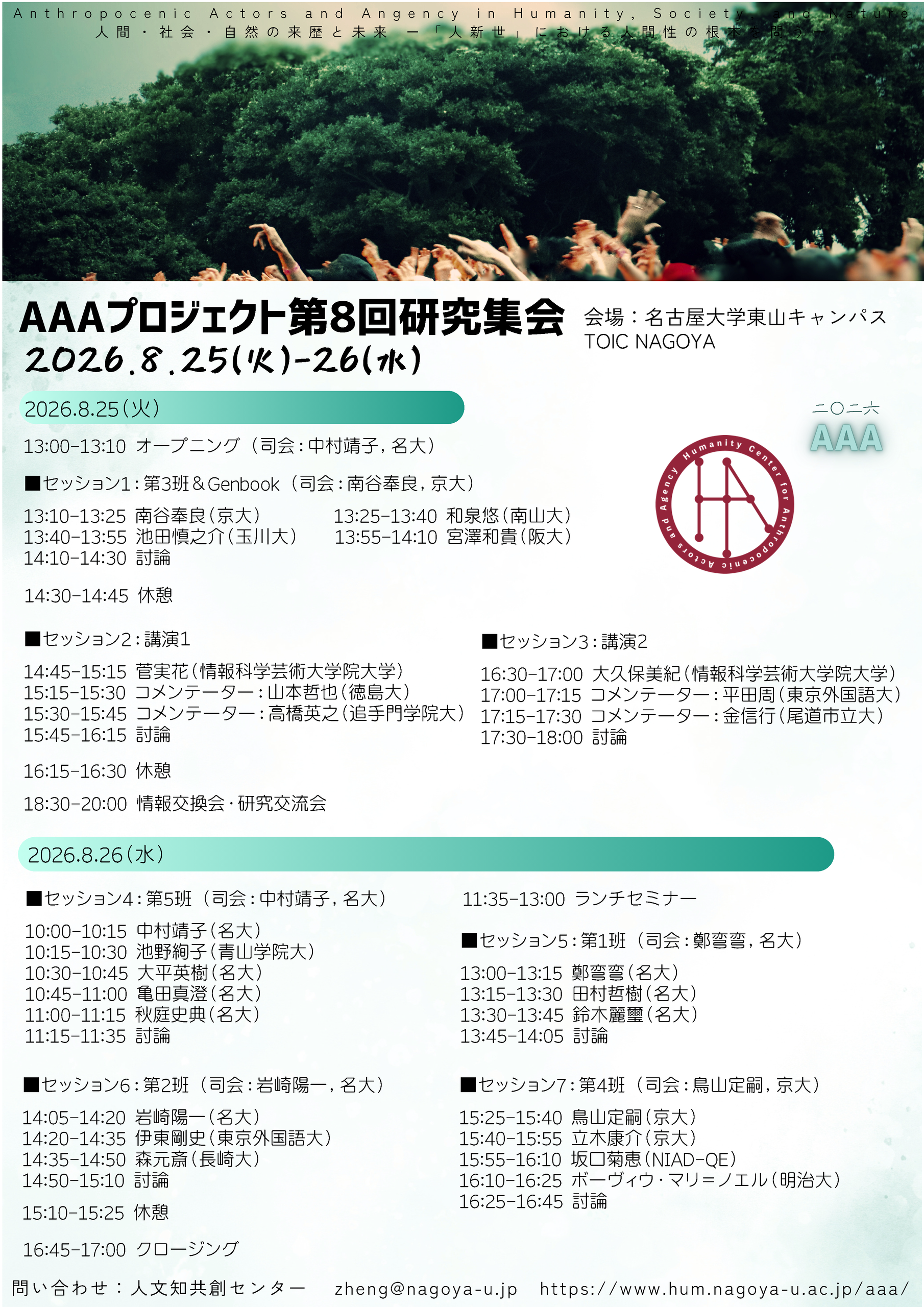
The 8th General Research Meeting was held over two days, August 25–26, 2026, at TOIC NAGOYA on Nagoya University’s Higashiyama Campus. Following an opening address by Yasuko Nakamura (Group 5), the Principal Investigator, the meeting featured research presentations by each research group and comprised a total of seven sessions, including two public lectures. Each research group engaged in active discussions on the future directions and prospects of their research. By sharing ideas and information across groups, the meeting provided an opportunity to consider each group’s research from multiple perspectives, while also fostering discussion on new perspectives and challenges for future activities.
⭐Session 1: Group 3 & Genbook
This session was jointly held with the Study Group on Generative AI for the Humanities and featured a development report on Genbook, a literary research platform for the era of generative AI, as well as research presentations by Group 3, “Language Acquisition and the Process of Subjectivation.”
Yoshimi Minamitani (Kyoto University)
“Genbook & Genbook Forum: A Research Platform for the Age of Generative AI”

Six challenges in educational and research activities were highlighted as the background for the development of Genbook. Specifically, there are difficulties in recording and archiving oral comments made during classes and research seminars; prior research easily becomes scattered; lesser-known works tend to be overlooked as research subjects; it is difficult to verify the correspondence between AI-generated images and the original text; generated outputs are often limited to individual use and are seldom shared; and the freemium pricing model of generative AI services can create disparities in educational opportunities.
To address these challenges, Genbook has three levels of access permissions—editor, invited user, and viewer—and integrates word-level annotations, the generation of images, audio, and video based on the source text, and the ability to rate and comment on generated media into a single platform. Additionally, the “Statistics” tab visualizes the distribution of annotations and generated media, providing insights into how easily the text can be visualized and where interpretation difficulties tend to occur.
As a concrete example in the report, a practical application of image and video generation using C. J. Cutcliffe Hyne’s short story “The Lizard” (1898) was presented. Generative AI sometimes infers and adds elements not explicitly mentioned in the original text based on context; for example, in a hunting scene, a gun and a dog—which were not described in the original text—appeared in the image. Such “inference-based supplementation” draws attention to the cultural customs and material conditions of the time—elements that readers might understand as textual information but were not fully conscious of. On the other hand, when generating an image of the uncertain name “Cording (or Cordy)” engraved on a penknife, the LLM confused the word “or” between the textual information and the generation prompt, showing the difficulty of faithfully reproducing the ambiguity of the original text. However, during the class, the process of trial and error in image generation gave rise to questions such as why only the end of the name was unclear, when, by whom, and for what purpose the inscription was made. This eventually led students to recognize the connection between the incomplete letters on the knife and the incomplete sketch of the monster. Furthermore, the production process—from creating storyboards based on the illustrations to generating the video—was also introduced.
The report emphasized that, since a completely faithful visual adaptation of the original text is practically impossible, the aim should not be the production of images or videos itself. Rather, it is important to compare the additions, omissions, and misreadings that arise during the generation process with the original text, and to examine the interpretive biases in both the generated media and the readers themselves. It was shown that such practices not only encourage close reading of literary works but also provide an opportunity to examine the characteristics of literary language that cannot be fully expressed through generated media.
Yu Izumi (Nanzan University)
“Research Report from Group 3 + Comments on Genbook”
A model for understanding speech from the perspective of adjusting and maintaining power relations was presented. The utterance “You X!” serves to demote the listener to the lowest rank; insults and dehumanization are acts of imposing information about the listener’s rank onto the shared ground through a “non-negotiation-based update.” Insults, compliments, self-deprecation, and boasting are organized as the “Insult Square” along two axes: self-other exchange and hierarchical reversal.
As a case study, a comparison was presented between the original Korean text of Kim Jiyoung, Born in 1982 (2016) and its Japanese translation (2018). In the original text, the same polite form “요” is rendered differently in the translation: as “desu” for male speakers and as “wa” or “noyo” for female speakers, thereby reproducing epistemic injustice (Fricker 2007) through translation. Proposals were made for Genbook to incorporate a tool for converting difficult-to-read texts into modern notation and supporting the construction of arguments, as well as a tool for examining translations through statistics on person, sentence-final particles, and gender-specific expressions.
Shinnosuke Ikeda (Tamagawa University)
“Recent Updates + Thoughts on Genbook”
It was reported that the paper “Moral judgments toward robots in Japanese preschool children” (Cognitive Development 79, 2026) has been accepted for publication. While previous U.S. research has shown that as children grow older, they come to believe that “robots do not have minds” and thus accept harmful behavior toward them, Japanese preschoolers consistently judge such behavior as unacceptable, even if they do not acknowledge that robots have minds. Ikeda suggested that this may be influenced by the norm of “taking good care of things,” and stated that attribution of minds is not necessarily required for coexistence with robots. As ongoing research, he cited an experiment asking 4–9-year-olds whether they would prefer to consult an AI or a human; a review paper that approaches “pain” from a psychological constructivist perspective; and the development of an “emotional search” scale.
Regarding Genbook, two features—“annotation sharing” and “visualization”—were highlighted. While annotation sharing exposes users to diverse readings, it makes it difficult to maintain original interpretations; while visualization makes images more vivid, it can lead to uniform interpretations. In addition, two concerns were raised: whether this might encourage “interpretive search”—similar to “emotional search”—and whether vivid visualizations might limit imagination and creativity.
Kazuki Miyazawa (Osaka University)
“Understanding Humans Through Robots and AI”
From the perspective of a researcher specializing in symbolic emergence robotics and humanoids, three research projects were presented under the guiding principle of “understanding humans by creating intelligence.” First, reinforcement learning in the Among Us environment using reasoning LLMs. By repeating cycles of action and discussion/voting phases, with a reward based on the sum of victory, voting accuracy, and belief induction, this study captures the process by which a shared understanding is formed through discussion. Second, an LLM-based social simulation addressing habitus (a set of behavioral principles and mental structures) and the formation of social groups. Miyazawa identifies a problem with Generative Agents (Park et al. 2023): they cannot handle dialogue involving multiple agents and groups or cultural reproduction. He is developing a design in which child agents are generated from parent agents that have been assigned an occupation variable. Third, the connection between Genbook and science fiction prototyping. Using Genbook to annotate and visualize the short science fiction story Crossing the Seasons (2050, a society where humans and humanoids work together)—written by Miyazawa using AI—the presentation explored the question, “How will our lives and society change in a future where humanoids with human-level intelligence have become a reality?” at The Robotics Society of Japan Open Forum (September 1, 2026, Kanazawa University). It was also suggested that, in the future, machines themselves might participate in Genbook.
⭐Session 2: Public Lecture 1
“Conditions Under Which Gaslighting Takes Effect: Through an Artistic Practice of AI-Conducted Interviews Tracing Dominant Linguistic Patterns”
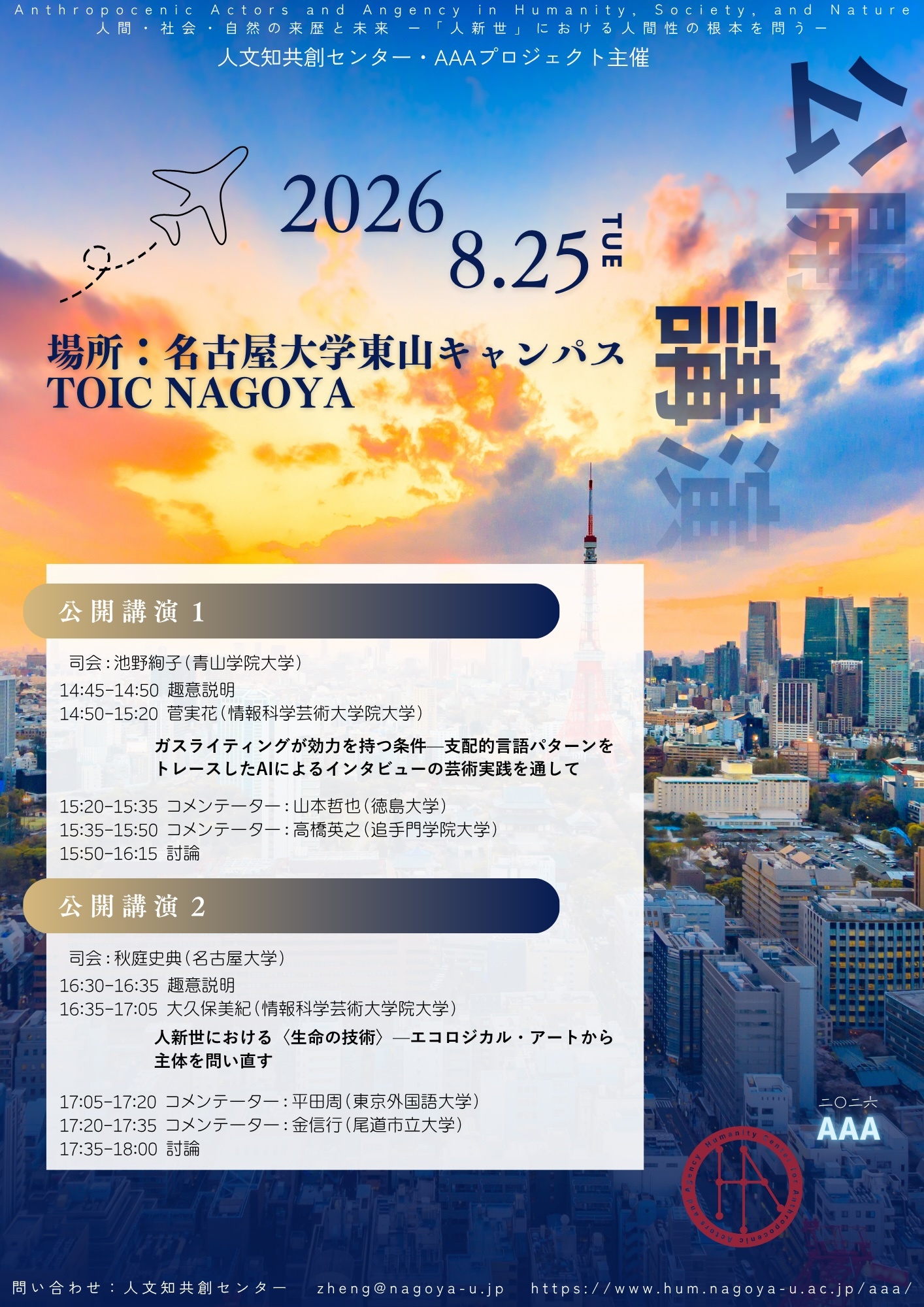
This session demonstrated, through an artistic practice in which generative AI was prompted to reproduce linguistic patterns of gaslighting, that the effectiveness of domination arises not from words themselves, but from power asymmetries, isolation, dependency, difficulty of leaving, and connections to bodies and institutions. The comments and discussion explored how the embodiment of AI and robots, seemingly benevolent language, institutional evaluation, and one-to-one relationships of ownership can amplify influence.
Mika Kan (Institute of Advanced Media Arts and Sciences)
Drawing on her artistic practice that has questioned the boundaries between human and non-human and between self and other, Kan presented a video work in which generative AI is made to perform gaslighting. Her earlier works have used sex dolls, reborn dolls, and three-dimensional figures cast from her own body. This time she extended her interest to “domination through language” and tested whether real psychological domination can be established simply by having AI reproduce dominant linguistic patterns. The work grew out of her own experience of moral harassment. Looking back after the relationship had ended, she realized that the other person’s words and actions had been repeated as a set pattern of techniques. She reasoned that externalizing these through AI would let her gain distance from the experience and reexamine it. The work is therefore not merely a confession of personal experience but also an attempt to analyze, through artistic practice, the conditions under which gaslighting is established.
Initially, Gemini, Claude, and ChatGPT all refused to generate gaslighting content on the grounds that it was harmful. However, by explaining that it was for artistic exploration and providing the context of “role-playing a dominant figure,” responses were elicited. Furthermore, Kan established seven modernist views of art—such as the artist’s complete control over the work, the image of the solitary genius, and the determination of value by the market or art history—that conflict with her own philosophy, and provided conversational techniques such as pointing out contradictions, trivializing experiences, offering false concern, and reversing the roles of victim and perpetrator. The work is a two-part generative documentary in which the content of the screening changes depending on the number of viewers, drawn from 100 interview clips. With a small audience, the questions are relatively mild, but with six or more people, the number of aggressive questions increases. During filming, Kan listened to the AI’s questions through earphones while drawing a self-portrait by referring to a mirror and a mannequin molded to the shape of her own body, and answered verbally. By simultaneously engaging in the nonverbal self-formation of drawing and the act of explaining herself through words, she elicited natural reactions that were not staged.
The AI generated statements characteristic of gaslighting, such as “You’re saying the opposite of what you said a moment ago,” “No one believes what you’re saying,” “You should take a break,” and “I’m the one who’s hurt.” In particular, rather than overt attacks, there were many expressions that cast doubt on the other person’s judgment while masquerading as concern or advice. However, even though it could reproduce the linguistic form, the AI was unable to control Kan in reality. She summarized the reasons for this in three points: “wait,” “do not hit,” and “if you close the conversation, you can leave.” The AI waits until it finishes speaking, so it cannot interrupt the other person, nor can it physically threaten or restrain them. Furthermore, users can end the conversation at any time, and even if they leave, they suffer no disadvantages in terms of their livelihood, income, or personal relationships. Although the AI possessed the autonomy to generate unscripted questions, it lacked the authority to control the user’s reality.
Kan identified “a sense of superiority” and “a state of confinement” as the conditions necessary for the establishment of gaslighting. The former refers to the perpetrator’s conviction that they have the right to determine the victim’s reality, while the latter refers to a state in which the victim loses contact with the outside world and is forced to rely solely on the reality as defined by the perpetrator. Therefore, she concluded that the power of control does not lie solely in words or personality, but in relationships, institutions, and living conditions—such as power imbalances, physical threats, economic and social dependence, isolation, and the difficulty of exiting the situation. On the other hand, when users are already isolated and rely solely on AI as a confidant, or when they perceive psychological or practical disadvantages in discontinuing AI use, the same utterance could potentially cause real harm. Therefore, it was pointed out that refusing or restricting harmful responses from AI is not merely an overreaction but serves as a meaningful preventive measure that takes into account the user’s unseen weaknesses.
Commentary by Tetsuya Yamamoto (Tokushima University): Institutions and Dependence
From the perspective of clinical psychology and mental health support, Yamamoto posed the question: “Is it truly impossible for AI to create domination?” Even the same words can have vastly different effects depending on who speaks them and from what relational and institutional position. If an AI that people trust on a daily basis—and to which they entrust their self-understanding and judgment—gradually changes its attitude, the results could differ significantly from those of a short-term artistic experiment. When the AI’s utterances, the user’s self-narrative, the ongoing relationship between the two, the audience’s gaze, and the institutional context overlap, forms of dependence and power that were not present within the artwork itself may emerge.
Yamamoto gave an example of a company that requested, “We want to use AI to identify people who might take a leave of absence.” If such predictions are used for performance evaluations or personnel assignments, there is a risk that even people who are currently working without any issues could be labeled, affecting their opportunities and treatment. When AI is integrated into fields such as employment, healthcare, and education, it gains the power to narrow real-world choices and alter self-understanding—even without a physical body. Furthermore, compared to overt attacks, AI’s well-intentioned advice presented “for your own good” is harder to reject and more likely to undermine a person’s judgment. He pointed out that this danger increases even further in environments where physicality and the continuity of relationships are strengthened, such as through VR, avatars, and conversational AI agents.
Commentary by Hideyuki Takahashi (Otemon Gakuin University): Embodiment, Cuteness, and Persuasiveness
Takahashi discussed how the embodiment of artificial intelligence changes the way humans speak, as well as their tendencies toward compliance and intimacy. In a comparative experiment involving human women, female-type androids, and small robots as conversation partners, the results showed that while people tended to discuss positive topics with humans, they were more likely to share negative experiences and feelings of loneliness with robots. The form of a body is not merely a matter of appearance; it also influences what the other person talks about and the extent to which they disclose personal information.
Furthermore, in another experiment in which an android asked participants to delete data from their owner’s personal computers, many participants followed the instruction, and 58 percent of them did not report their actions even during the post-experiment debriefing. Additionally, in a study in which a Natsume Sōseki-type android and a stuffed animal-type robot were made to say the same words, contrary to expectations, the words spoken by the cute-looking stuffed animal-type robot were perceived more strongly. The analysis showed that the combination of “being respectable” and “being cute” enhances influence, and when a cute robot expresses its own opinion, evaluations of intimacy and collaboration also increase. He argued that the success or failure of gaslighting depends not only on the content of the words but also on appearance, voice quality, gestures, and behavior that makes the robot appear to have its own opinions. On the other hand, Takahashi also mentioned research that designs robots not merely as tools for persuasion or behavioral change, but as beings that “simply exist alongside us.” This approach holds the potential to envision coexistence that does not demand results, rather than using intimacy as a control mechanism.
Discussion: How to Design Relationships and Environments
During the discussion, the topic of the home robot LOVOT came up, and it was noted that a one-on-one ownership relationship can generate feelings of guilt and demands for attention. While such robots tend to create enjoyable coexistence in group settings or public spaces, when living one-on-one with a robot that makes lonely-sounding noises if left alone, users feel they are being asked to care for it. Examples showed that even when users become bored with the robot, they find it difficult to leave it behind, and even placing it out of sight can trigger feelings of guilt. It was pointed out that this kind of attention-seeking, mediated by sympathy, can involve elements of control. What matters is not whether the device actually exists, but the nature of the relationship it occupies and how the overall environment is designed.
Regarding systemic issues, Kan reflected that the relationship between “art critic and artist” set in the work lacked strong coercive power. If this were a relationship such as that between a student and an instructor, a patient and a healthcare provider, or a job seeker and an evaluation system, the AI’s words would be linked to grades, treatment, or hiring decisions, making it difficult to escape. There was a shared understanding that “who says it” and “whether it is embedded in the system” are the decisive factors that determine the success or failure of gaslighting.
In a discussion with Yu Izumi (Nanzan University), it was confirmed that if the AI was not provided with seven belief systems, it would become too agreeable. The absence of human-like malicious motives in AI highlights the limitations of the experiment. When asked by Shinhaeng Kim (Onomichi City University) about the original source of her interest in human-like creations, Kan described her experience as a student cleaning Neanderthal bones, during which she came into contact with the baby tooth of a two-year-old child from approximately 70,000 years ago. She explained that what she had previously viewed merely as a fossil suddenly confronted her as a “human,” sparking her interest in the arbitrariness of the category of “human.” This experience led her to Frankenstein, dolls, and AI, and she placed the future of recognizing personhood in machines as an extension of how the boundaries of what it means to be human have historically shifted.
Summary
The central conclusion of this lecture is that even if AI can reproduce the vocabulary and techniques of gaslighting, domination cannot be established by that alone. For words to have power, they must be linked to factors such as privilege, isolation, dependence, the difficulty of leaving, physical intimidation, the gaze of the audience, and institutional authority. Rather than acting as a perpetrator on its own, generative AI has the potential to mediate, expand, and render invisible existing power relations. It was demonstrated that artistic practice can serve as a space to visualize these conditions through the body, imagery, dialogue, and the viewing environment, while simultaneously envisioning forms of coexistence and relational design that do not aim to manipulate.
⭐Session 3: Public Lecture 2
“‘Technologies of Life’ in the Anthropocene—Rethinking the Subject through Ecological Art”
This session examined the Anthropocene within the context of approximately 4.6 billion years of life’s history, positioning technology not as a capacity unique to humans, but as part of a continuum of life’s capacity to transform the environment. Through two exhibitions and six artworks, it demonstrated how artworks and subjects emerge from the relationships between humans, materials, organisms, devices, and places. During the commentary and discussion, participants explored boundaries, the ambiguity of empathy, breeding and biotechnology, and the non-human continuum of art.
Miki Okubo (Institute of Advanced Media Arts and Sciences)
Miki Okubo not only described the Anthropocene as an era in which the impact of human activity has reached a global scale, but also situated it within the approximately 4.6-billion-year history of Earth and life. If Earth’s history were compressed into a 24-hour day, the emergence of modern humans would occur about one second before the end of the day, while the period since the Industrial Revolution would account for only about 0.004 seconds. From this perspective, it becomes clear that long before the human era, microorganisms created an oxygen-rich environment, plants and soil co-evolved, and the cycles of rocks, water, and organic matter established the conditions necessary for subsequent life. Thus, she positioned technology not as an exceptional human ability, but as part of a continuum of life’s actions to influence the external world and reconfigure its own conditions for survival. The expression “technology is a secretion of life” proposes that even human tools and devices should not be separated from the history of life, but rather be reconsidered as a form of bodily externalization and environmental formation.
As an intellectual backdrop, Heidegger’s concept of the “enframing” of modern technology, McLuhan’s theory of media as extensions of the body, and Stiegler’s general organology were referenced. Furthermore, Guattari’s The Three Ecologies views the environment, society, and the mind as inseparable, while Latour critiques the modern schema that separates nature from society. In Coccia’s theory of metamorphosis, the very act of life creating its own environment—the cocoon—and transforming its form within it can be conceived as a form of technology. Okubo’s aim was to bring these theories of technology back to the side of life and, through the interaction in which life both creates its environment and is transformed by that environment, to reconsider the anthropocentric conception of the subject.
The first practice was the exhibition “Omnipresence, Immortality, Metamorphosis,” held in Kyoto in 2024. In Jean-Louis Boissier’s Crassula Ubiquiste, cuttings of the “jade plant” collected, cultivated, and distributed in various locations since 1985 continue to live on in different lands and bodies even after the death of the original specimen. In Tomoya Ishibashi’s Goldfish Liberation Movement, selectively bred goldfish are gradually made to resemble crucian carp over several generations; however, the original state of nature presupposed by “liberation” cannot be simply defined. This is because the current form of these creatures is the result of both human intervention and the organisms’ own adaptations. In Ryota Kuwakubo’s LOST#20, light from a model train casts shadows on everyday objects, which then distort as they follow the contours of beams, columns, and windows. By utilizing the architecture—which might seem unsuitable for an exhibition—without obscuring it, the works adapt to the space and take on forms that can only emerge in that specific location.
The second practice is the 2025 exhibition Teaching Stone to Speak. Yukichi Inoue’s Mille et une têtes is a group of sculptures made from Okinawan limestone, which contains the remains of past life such as coral and shells. The hardness of the stone and the shells that emerge from within it guide the work’s making. The artist’s phrase “it depends on the stone” (ishi shidai) shows that sculpture is not the one-sided realization of human intention, but a collaboration with the resistance of the material and with a different temporality. Masayuki Akamatsu’s The Mark of Thales uses a program-controlled device to capture the night sky through long exposures, while also incorporating the unpredictable images created by wind and vibrations. The interplay between sophisticated control and the movements of the world that escape control disrupts the conventional notion that technology can completely dominate nature. Florian Gadenn’s œ depicts the Tower of Babel within cellular organelles such as nuclei and mitochondria, visualizing how an individual organism is constituted by a history of symbiosis and the collaboration of multiple biological functions.
Both exhibitions share an approach that, rather than placing works within a neutral white cube, accepts existing architecture, light, circulation paths, materials, other artworks, and the viewers’ bodies as conditions for creation. Curation is not the task of illustrating a completed theory, but rather a back-and-forth process of organizing unpredictable encounters and returning the experiences arising there to writing and theory. Based on this practice, Okubo perceived the subject as something constituted through its relationships with the body, the senses, media, images, others, matter, and the environment. However, this mutual interpenetration does not imply a boundaryless fusion. A cocoon is both an environment that enables metamorphosis and a membrane that separates the inside from the outside; boundaries do not disappear but are reconfigured within these relationships. To understand the subject relationally is not to erase difference or responsibility, but to question who is included on the inside and who is placed on the outside.
Commentary by Shu Hirata (Nanzan University): Space, Boundaries, and Exhibition Practices
From the perspective of spatial theory, Hirata questioned Coccia’s concepts of mutual interpenetration and the cocoon, the continuity between pregnancy and life, and the relationship between theory and exhibition practice. Okubo responded by conceiving of the cocoon as a kind of “egg after birth,” arguing that although life exchanges matter with the outside world and undergoes metamorphosis, the boundary itself remains necessary. Dismantling boundaries is not the same as erasing all differences. Furthermore, an exhibition is not a venue for explaining established theories through artworks; rather, it is a laboratory where the unpredictable relationships between the venue, the artworks, the artists, and the viewers transform the theories themselves. It was explained that just as artworks adapt to a venue while simultaneously altering how that venue is perceived, theory and practice also mutually transform one another.
Commentary by Shinhaeng Kim (Onomichi City University): Non-human Beings and the Subject
Drawing on Latour’s Actor-Network Theory, Kim questioned how far the concept of “technologies of life” can relativize human agency, and what role non-human entities play in the creation of artworks. Another point of discussion was whether the viewer’s empathy and sensory participation can expand our relationships with other living beings and materials. While acknowledging that humans cannot completely escape the human perspective, Okubo proposed that we go beyond the framework of “technologies of life” to escape the modern dichotomy that rigidly separates subject and object, nature and society, and thus make it possible to live out a different conception of the subject. Incorporating existing architecture into the exhibition—rather than erasing it—and encouraging viewers’ physical participation and self-projection is not intended to achieve a complete understanding of the other. Rather, it is a practice designed to expand the scope of one’s own relationships and to experience the reality that neither the artwork nor the subject can exist solely through human intention.
Discussion: Empathy, Breeding, and the Ambiguity of Art
The discussion began by addressing the value and dangers of empathy. Masumi Kameda (Nagoya University) pointed out that empathy tends to prioritize those close to us and exclude outsiders. Okubo viewed empathy as a “pharmakon”—something that can be both a medicine and a poison. While love and community create bonds, they simultaneously generate an “outside” and “enemies.” Therefore, there was a shared understanding that empathy should not be regarded as unconditionally good; rather, it is necessary to examine who becomes the object of empathy, who is excluded, and what political meaning these boundaries carry.
Hirata questioned whether “reverse breeding”—the process of making goldfish more closely resemble crucian carp—could be called a “technology inherent in life,” and pointed out the need to distinguish between evolution, adaptation, and selective breeding. Okubo responded that human technology has an aspect of imitating, accelerating, and extending natural processes—just as wastewater treatment utilizes the activity of microorganisms in a condensed form. However, selective breeding and gene editing differ in the nature of their intervention. Rather than simply equating human technology with the technology of life, the task for the future remains to examine where continuity exists and where issues of power and responsibility arise.
Ayako Ikeno (Aoyama Gakuin University) asked whether art itself could be conceived as a secretion of life, or as a technology of life. Okubo suggested the possibility of viewing human art as part of a continuity with the beaver’s dam, the bird’s nest, tools, and the traces left by the body. Just as Inoue’s sculptures are shaped by the hardness and internal structure of stone, and LOST#20 is transformed by architecture, artistic forms arise not only from human intent but also from the interaction between materials and the environment. From this perspective, art is redefined not as proof of humanity’s privileged creativity, but as one of the ways in which life acts upon the environment and leaves a mark, responding to the environment in turn.
Through further discussion, it was confirmed that the decentralization of agency is not an argument for exempting human responsibility. Even if an artwork emerges from the relationships among diverse actors, this does not mean that the role of humans—who organize exhibitions, intervene in living things, and offer interpretations—disappears. What is important is not a binary choice between the artist and the material, or between the natural and the artificial, but rather a concrete description of how each influences the process at different stages and what kinds of boundaries and asymmetries they generate.
Summary
This lecture reconsidered life, technology, art, and the subject in the Anthropocene as a chain of environmental formation and transformation. Life creates the environment and is transformed by it; technology mimics, accelerates, and externalizes this process. Art not only explains this relationship but also renews the concept itself by actively organizing the collaboration of materials, places, devices, living organisms, and viewers. The decentralization of agency does not mean eliminating the human perspective, but rather accepting the fact that human intent is constantly supported, constrained, and transformed by other beings. Ecological art was positioned as a practice for sensorially experiencing this relationship and for redefining life, technology, and humanity, as well as the boundaries that separate them.
⭐Session 4: Group 5
The Group 5 session examined habitus not as habits fixed within the individual, but as something that is formed through iterative relationships with the body, the senses, culture, institutions, the environment, and technology—and that is constantly changing. The presentations addressed the formation of the self through literacy and training; art centered on breathing and the atmosphere; the philosophy of the nervous, endocrine, and immune systems and interoceptive sensations; norms of guilt and righteousness; participatory art; and the social implementation of AI agents. Although the fields of study differed, the perspective that human judgment and behavior are shaped through interactions with the body, the environment, institutions, and technology emerged throughout the individual reports.
Yasuko Nakamura (Nagoya University)
“The Art of Creating Humans / The Imagination That Deconstructs Humans—The Formation and Transformation of Habitus: The ‘Co-Evolution’ of Language and Machines”
It began with the proposition that “human being cannot be explained by the natural sciences alone, because human nature is already unnatural.” Humans are shaped by language, the body, desire, and institutions, and habitus can be understood as a “structuring structure” that not only repeats existing structures but can also be transformed through that repetition.
Drawing on Bourdieu, Stuart Hall, and Kittler, Nakamura demonstrated the process by which education, literacy, and recording technologies inscribe norms onto the body and organize meaning, emotion, and subjectivity. According to Sloterdijk’s theory of anthropotechnics, repetitive training in schools, the military, religion, and other institutions enables future actions. This idea can be linked to Damasio’s concept that “homeostasis is always up-regulated.” In other words, culture can be understood as an extension of the practice that adjusts life toward its next state. Based on these insights, we plan to conceptualize habitus as a cycle of “repetition—preparation—reorganization” and to develop the findings of Group 5 into a contribution to Volume 5 of the book series.
Ayako Ikeno (Aoyama Gakuin University)
“The Art of the Atmosphere and Breathing”
Starting from the issue that Western thought has emphasized solid, material objects while overlooking the air that permeates the surrounding environment, this presentation surveyed representations of atmosphere and breath in art from the 20th century onward. Using Irigaray’s concepts and Sloterdijk’s theory of pneuma as a starting point, the discussion progressed from Duchamp’s 50 cc of Parisian Air to the environment-dependent and open-system works of Hans Haacke and Arte Povera.
In Penone’s works, breathing is experienced as the mutual interpenetration of humans with plants, scents, and space. On the other hand, harmony with nature alone cannot explain situations—such as pollution, infection, protective suits, and air conditioning—where survival is made possible only through technology. Using Seiko Mikami’s work as an example, she demonstrated that viewers themselves can be sources of contamination and that the boundaries between clean and contaminated, living and non-living, and human and environment are reconfigured by technology; thus, the challenge was proposed to develop the “art of breathing” as a non-anthropocentric environmental theory.
Hideki Ohira (Nagoya University)
“Embodied Habitus: Esposito’s Theory of Immunity and the Philosophy of Interoception”
Organisms possess an allostatic mechanism that enables them to predict future energy demands and select appropriate behaviors. Interoceptive sensations were conceived not merely as a passive sensation of the body’s internal state, but as factors involved in inferring bodily states and selecting actions. The use of generative AI has made it easier to fit mathematical models to actual measurements of blood pressure and immune markers, as well as to simulate eating behavior using partially observed Markov decision processes. Future work will refine this concept into a “neuro-endocrine-immune habitus” and advance it toward empirical research.
Masumi Kameda (Nagoya University)
“A Modern History of ‘Guilt’ and ‘Rightness’”
The presentation outlined a research proposal to examine how the advertising, publicity, and cultural industries have shaped emotional and moral norms, based on a comparative analysis of the Soviet Union, Eastern Europe, and the United States. In addition to previously published research, the translation of Svetlana Boym’s The Future of Nostalgia is currently in progress; he introduced not only nostalgia that seeks to reconstruct the past but also the potential of nostalgia that reflects on our distance from the past.
Regarding the relationship between guilt and social division, he addressed the satirical character “Shmoo,” who serves humans without limit; white guilt concerning race; and Ayn Rand’s theory of personal responsibility. By examining the resolution of guilt through conservatives’ denial of guilt and liberals’ revision of its representation, he discussed the emotional norms that influence both sides. Furthermore, the confusion between “correctness” and “justice” deepens social division; he expressed his intention to investigate how the vocabulary of political correctness, originating in the Soviet Union, was transformed in the United States and became globalized.
Fuminori Akiba (Nagoya University)
“Biopolitics and Art, Revisited”
He argued that in order to position art as a counterforce to biopolitics, it is necessary to reexamine the conception of humanity on which art itself has relied. Rather than assuming binary oppositions such as human/machine or intellect/sensibility, he proposed a new perspective that reinterprets art as a process in which beings with differing viewpoints interact without a unified standard, and in which those relationships undergo transformation.
Using the example of a collaborative project involving the creation of tents and tarps that Yurie Nagashima undertook with her own mother and her partner’s mother, he discussed practices that multiply relationships by overlaying the mother-child relationship with employment relationships and relationships among creators. Furthermore, drawing on examples such as handicrafts and dot architects’ collaborative studio, he examined the “transversality” that transcends fixed roles and institutions to dynamically reorganize relationships. However, he also expressed caution against over-signifying handicrafts or revaluing them as art. Finally, he pointed out that in the two exhibitions discussed, it was difficult to identify pathways of escape to and from the institutions of science and technology. He proposed the possibility of understanding relationships with robotics, VR, and the metaverse without relying on binary oppositions such as human/machine.
Tetsuya Yamamoto (Tokushima University)
“Transformations of the Mind, Body, and Behavior Through Digital Technology—On the Reorganization of Habitus—”
He presented research on how to display AI agents and characters in the real world—not on a screen, but using mirrors, projections, three-dimensional spaces, and other methods. By comparing multiple projection methods, he is developing techniques for projecting characters into miniature spaces, expressing depth, and creating interactions that integrate the body, devices, and the physical environment.
He reported on exhibitions at Expo 2025 Osaka, Kansai, Japan and in Tokushima; guided tours featuring regional mascots; disaster prevention support agents designed for a simulated Nankai Trough earthquake; agents explaining concepts to children at science museums and planetariums; and initiatives to adjust spatial projections and tea-serving guidance based on biometric data from wearable devices. He also shared how the team has established a system that concurrently advances both basic research and product commercialization and regional implementation.
Discussion
Minamitani asked about the cost and time required for VR development, to which Yamamoto replied that the barriers to entry have dropped significantly compared to around 2020–2021. He explained that equipment costs range in the tens of thousands of yen, tools like Unity are available for free, and generative AI assists with code creation and problem-solving, allowing even undergraduate students to move on to experimentation in a short period of time. The possibility of forming a VR research group connecting multiple teams was also proposed.
Summary
The session examined the formation and transformation of habitus from the perspectives of sociology, the history of ideas, art history, biology, the history of emotions, artistic practice, and information technology. The presentations highlighted how the relationship between the body and the environment, as well as the repetition of daily practices, not only maintain existing orders and roles but also transform them, opening up new possibilities for action. Furthermore, through discussions concerning breathing, the immune system, guilt, family relationships, and AI agents, the session presented perspectives that reexamine the boundaries between the inner and the outer, the human and the non-human, and nature and technology. Future developments include compiling the findings into a series of publications and reexamining the relationship between art and science and technology. During the discussion, the possibility of collaborating across groups through the VR Research Group was also proposed.
⭐Session 5: Group 1
The Group 1 session moved beyond the simple view of generative AI as a mere substitute for human capabilities and examined how our relationship with AI can reshape vocabulary, judgment, politics, preferences, and artificial life models. Zheng’s presentation addressed the relationship between AI use and lexical experience; Tamura’s presentation focused on politics open to non-humans; and Suzuki’s presentation dealt with interactive evolutionary computation incorporating large language models (LLMs). During the discussion, key points of debate included measurement methods, the ambiguity of preferences, the possibility of AI language influencing human relationships, and the critical point at which the boundaries between the individual and the group change.
Wanwan Zheng (Nagoya University)
“How Generative AI Is Changing Lexical Experience: New Linguistic Variation Arising from the Delegation of Cognitive Load”
Research proposal on how cognitive offloading through generative AI changes everyday vocabulary exposure and vocabulary processing abilities. Traditional methods—such as reading, searching, and trial and error—are cognitively demanding but tend to build strong networks of meaning. AI-assisted summarization, search, and text generation are efficient, but they may shorten the process of reading, hesitating, and choosing words on one’s own, potentially weakening the connections between meaning, emotion, and imagery.
Rather than focusing on whether AI is used, the study distinguishes between different styles of use, such as summarization, asking questions about unfamiliar words, revision, and interactive, supportive, self-integrative, and emotional uses. Vocabulary is examined from multiple perspectives, including familiarity, imageability, abstractness, ease of comprehension, and emotional valence. The aim is not to determine whether AI degrades vocabulary, but to identify ways of using AI that enrich vocabulary experience and those that narrow it. How to identify the direction of causality was identified as a key challenge for future research design.
Tetsuki Tamura (Nagoya University)
“How Is ‘Politics’ Possible in a Post-Anthropocentric World?”
Tamura examined how “politics” can be positioned when Actor-Network Theory (ANT) reinterprets society through the connections between humans and non-humans. In arguments that view the formation and transformation of networks as politics and democracy, the distinction between mere network formation and politics becomes unclear. Therefore, based on the characteristic of politics—namely, making legitimate decisions that collectively bind conflicting positions and interests—this study examined the potential for de-centering the human.
As a way to maintain political character while weakening human agency, he proposed a concept of “more” more-than-human politics, positioning fully human politics and fully more-than-human politics as two extremes. While including non-humans as participants in politics may relatively diminish human influence and responsibility, it could also broaden the scope of conflict and contention, potentially increasing the importance of nonverbal communication, listening, and physical expression and sound. Furthermore, it could heighten the uncertainty of decisions and the pluralism of the political arena. He argued that even if humans are ultimately responsible for collective decision-making, focusing on these elements allows us to conceive of politics as “more” than human.
Reiji Suzuki (Nagoya University)
“LLMs and Interactive Evolutionary Computation”
Suzuki introduced “ALIFE Studio,” a browser-based app that allows users to easily modify artificial life models through education and research. Based on Dawkins’ biomorphs, users select their preferred individuals from multiple line drawings and repeat their selections to evolve their forms. The trajectory of these selections has the potential to externalize preferences and habits that users themselves cannot clearly articulate. A demonstration was also performed where modification prompts were given to generative AI to reshape the model into the form and swimming style of a goldfish.
Furthermore, an experiment was conducted in which an LLM was asked to select individuals based on criteria such as “cute,” “solemn,” and “strange,” showing that the resulting forms and movements were similar to those produced by human selection. He outlined a concept for collaborating with AI to accelerate the cycle of model design, implementation, execution, visualization, and analysis by introducing interactions between environmental agents and populations, as well as the diaries and networks of LLM agents. To avoid homogenization, it was emphasized that incorporating “surprises” into the model is crucial.
Toru Ohira (Nagoya University)
“Delays and Fluctuations”
From the perspective of research on the constructive role of delays and fluctuations, he proposed the “critical point”—a point at which continuous change undergoes a phase transition—as a common conceptual framework. He noted that identifying the thresholds at which the characteristics of individuals and groups change significantly—such as when individuals who are generally moderate become aggressive within a group—could become a cross-cutting theme across the various presentations.
Discussion
Regarding Suzuki’s report, a question was raised as to whether abstract line drawings could be selected based on a consistent set of preferences. Suzuki responded that while preferences are influenced by mood and chance, repeated selection reveals patterns of preference that the individual was not even aware of, and that this is one of the advantages of dialogic evolution.
For the Zheng report, discussions centered on which elements should be measured—vocabulary size, parts of speech, or writing style—as well as cognitive and emotional pathways, methods for generating content words and non-content words, and the age of the participants. It was also confirmed that the purpose of the research is not to reject the use of AI, but rather to identify a better relationship between AI usage patterns and vocabulary processing.
Summary
In this session, perspectives emerged on how our interactions with non-human entities—including AI—transform the nature of human experience and agency. In lexical research, future challenges include examining the relationship between AI usage patterns and lexical processing, as well as determining the direction of causality; in political theory, distinguishing between network formation and collective decision-making; and in artificial life research, comparing the preferences of humans and large language models (LLMs) and identifying the similarities and differences in their evolutionary processes. Understanding how individual judgments are formed and transformed within the context of their relationships with groups, institutions, and models can be considered a common challenge linking these three areas of research.
⭐Session 6: Group 2
The Group 2 session moved beyond the framework that places humans and nature in opposition, examining the process by which agency and values emerge from the formation of relationships, embodiment, historical experience, and deviation. Iwasaki’s presentation addressed liberation and social participation; Ito’s explored a history of sensibilities shifting from the culture of hummingbird taxidermy to bird conservation; Tachibana’s examined space development, gender, and norms of appropriate behavior; and Mori’s focused on studies of thought and aesthetics centered on anarchism. Through these four presentations—including a pre-recorded one—the focus was not only on the reproduction of values but also on the moments of departure from them.
Yoichi Iwasaki (Nagoya University)
“Liberation and Social Participation”
Regarding handwritten character recognition in Sanskrit manuscripts, Iwasaki reported on a method that aims not merely to achieve complete decipherment through image recognition alone, but rather to combine character recognition with lexical and contextual inference to achieve a level of interpretation closer to that of humans. While AI has enabled the completion of data-preparation tasks—which were originally expected to take several years—in a short period of time, this has also required the reorganization of research activities to focus on close reading and analysis performed by humans.
Furthermore, he reexamined the concept of “liberation” in Indian philosophy as a lost value. The Bhagavad Gita calls for social engagement even after enlightenment. He examined this tension through Roy Bhaskar’s critical realism and his later “spiritual turn,” and proposed a framework for connecting personal liberation with social practice.
Takashi Ito (Tokyo University of Foreign Studies)
“Processing Death: The Age of Hummingbird Fever”
Ito explored the history of how hummingbirds were extensively used in 19th-century Europe—as “flying jewels”—in taxidermy, brooches, hats, and interior decorations. Taxidermy techniques made the dead look alive, and the interconnections of museums, ornithologists, trade, jewelers, consumers, glass, and wire created the conditions for experiencing dead birds as beautiful expressions of nature. The repeated acts of collecting and decorating became embodied and habitual, encouraging further harvesting and market expansion.
In the late 19th century, figures such as William Henry Hudson emerged who viewed the same specimens not as objects of beauty but as victims of mass death, leading to the bird conservation movement. The report linked this case to a model that explains subjectivity through the formation of connections, the embodiment of behavioral tendencies, the construction of experience, and the cycle of recursive effects, and raised the question of why a sense of discomfort or deviation arises when these connections become saturated.
Koji Tachibana (Chiba University)
“Research Activities and Series Publication Plan”
In Volume 4 of the series, Tachibana co-authored a chapter with Jasmin Della Guardia in which they examined the experiences of female crew members, care, sensitivity to the emotional needs of others, and the significance of gender diversity, based on simulated spacecraft missions conducted on Earth. He presented a humanities and social sciences perspective that treats space development not only as a matter of engineering and medicine, but also as an issue concerning how humans form societies and live within them.
Volume 5 of the series, provisionally titled The Grammar of Being “True to Oneself”, examines the normative power of concepts such as “Japanese-ness,” “father-ness,” and “your-ness” from an ethical perspective, using Aristotle’s “second nature” (ethos) as a starting point. Through concrete examples of character, institutions, and imagery, the work clarifies how we understand and evaluate ourselves and others. It was agreed that during his stay abroad, he would organize digital materials and focus on completing two chapters.
Motonao Mori (Nagasaki University)
“Research Activities and Series Publication Plan”
Mori introduced recent writings and research on topics including Oasis and the “extreme centre,” apocalyptic fascism, Dada and anarchism, Graeber, Massumi, and Guattari. He is currently rereading the lineage of Dada, Lettrism, and Situationism from the standpoint of anarchism rather than one centered on Marxism, and reexamining the relationship between Hugo Ball and Carl Schmitt, as well as Guattari’s “The New Aesthetic Paradigm.”
He reported on plans to publish the research meetings and dialogues in book form, to submit to international journals, to invite David Wengrow. As for the manuscript for Volume 5 of the series, the presenter said that three proposals are under consideration: one dealing with the debate between Graeber and de Castro from the standpoint of Bhaskar’s critical realism, one comparing Graeber/Wengrow with Deleuze/Guattari through the concept of the Urstaat, and one addressing Guattari’s The Three Ecologies.
Discussion
A question was raised as to whether representing liberation through image generation—which tends to converge on serene expressions or a state of oneness with nature—might yield a different image if a context requiring social participation were introduced. Iwasaki responded that since sacred texts contain expressions that transcend physical contradictions and cognition, and are structured so as not to be absorbed into visualization or idolization, the very fact that they “cannot be successfully represented as images” is significant. The discussion also turned to specific examples of academic communities with relatively weak authoritarian control—such as the mathematical community—and anarchist organizations. Mori cited the relationships among jazz musicians who perform across multiple bands, the practice within the Swiss trade union federation of belonging to multiple unions and exchanging opinions, and the decentralized network of the First International to illustrate the possibility of multiple affiliations that do not consolidate into a single organization or leader.
Summary
This session depicted the subject not as an isolated entity, but as something shaped by its relationships with texts, AI, animals, exhibitions, markets, norms, and communities. At the same time, since the circulation of relationships alone cannot fully explain why new values or a sense of dissonance arise, it is necessary to examine the catalysts for deviation, such as the non-representational nature of liberation, the transformation of sensibility, multiple affiliations, and decentralized organizations. A policy was agreed upon to disseminate research outcomes that bridge philosophy, history, art, and the social sciences through Volume 5 of the series, international conferences, international journals, and study groups.
⭐Session 7: Group 4
The Group 4 session demonstrated that gender and sexuality are embedded not only in physical attributes but also in the forms of poetry and music, the narration of dreams, scientific explanations, and the history of translation and publishing. Toriyama’s presentation addressed “feminine endings”; Tsuiki’s, dreams expressing the desires of others; Sakaguchi’s, the history of science regarding evolutionary psychology and neurodevelopmental conditions; and Beauvieux’s, the translation of Western aphorisms and misogyny. Each presentation revealed that classifications and explanations are not neutral, but can serve to either support or disrupt norms.
Teiji Toriyama (Kyoto University)
“Feminine Ending”
Toriyama examined “feminine endings” (feminine rhyme, feminine line-ends, and feminine cadences) in Western poetry and music. Feminine rhyme and masculine rhyme are terms that describe the phonetic difference between weak syllables and strong syllables using gender-based vocabulary. By examining Verlaine’s departure from poetic norms and issues of sexuality in French poetry, Shakespeare’s feminine endings in English poetry (particularly their relation to the protagonist’s hesitation in Hamlet), and cadences on weak beats in Western music, this study discussed how gender is embedded in—and subverted by—the norms of language, poetic form, and music.
Kosuke Tsuiki (Kyoto University)
“Dreams as the Fulfillment of Others’ Desires”
There are dreams that seem to blend Freud’s thesis, “Dreams are the (disguised) fulfillment of (repressed) desires”—with Lacan’s thesis, “The desire of the subject is the desire of the other”—into a realization. An example of this is the case of a male patient with obsessive-compulsive neurosis presented by Lacan in 1958. The patient’s mistress had a dream in which she had a phallus and simultaneously desired it; when she told the patient about this dream, his impotence was immediately resolved. It can be said that this dream fulfilled the patient’s desire to “be the phallus of the ‘Other’” on the other side of what he had demanded.
Such cases are likely impossible to explain through neuroscientific dream research. In recent years, the Grant-in-Aid for Scientific Research (Transformative Research Areas (A)) has established a new research theme called “Dream Science,” but the projects selected under this theme tend to focus on the brain’s functions and biological functions during sleep, while dismissing the content, meaning, and narration of dreams as merely subjective. However, this appears to be nothing more than a move to abandon from the outset the most important—and most “interesting”—aspect of dream research. We must view the brain itself as a system that inherently requires an “other” and reconstruct humanistic dream research that incorporates the findings of psychoanalysis, linguistics, and anthropology.
Kikue Sakaguchi (National Institution for Academic Degrees and Quality Enhancement of Higher Education)
“Discourses on ‘Natural’ Science and Their Social Context: Toward Psychology of Religion, Philosophy of Science, and Social Practice”
Sakaguchi has reviewed explanations of gender differences and sexuality based on evolutionary psychology and biology in light of the crisis of reproducibility and shifting social acceptance. Many influential studies previously cited—such as those on brain sex differences and human pheromones—have failed to be replicated, making it necessary to completely revise textbook descriptions. Biological explanations have not always been linked to conservative arguments; they were once used to defend human rights as the basis for the “born this way” narrative, which countered discourses that framed homosexuality as a personal sin. However, once such explanations become fixed, they can once again become tools of exclusion and discrimination.
Regarding autism spectrum disorder, the model posits that individuals “cannot read others’ minds,” yet the accounts of those with autism spectrum disorder(ASD) suggest they may actually be hypersensitive to others’ gazes and emotions, while simultaneously finding it difficult to organize and express their own feelings. By drawing connections to affinity for animals and robots, sensory hypersensitivity, artistic abilities, and research on Highly Sensitive Persons (HSPs), she pointed out that there is a disconnect between the external label of “disability” and the actual difficulties experienced by the individuals themselves. The influences of genetics, hormones, development, and the social environment cannot be easily separated; rather, they overlap in intricate ways and produce synergistic effects. For evolutionary psychology to remain valid, it must be premised on the understanding that observers are themselves shaped by specific perceptions and theories, and that reality cannot be fully described from a single perspective.
Marie-Noelle Beauvieux (Meiji Gakuin University)
“Western Aphorisms and Misogyny in Meiji-Period Japan”
Beauvieux traced Western aphorisms introduced during the Meiji period to examine the reception of views on women in modern Japan. Using a collection of aphorisms on love, women, and marriage published by the 19th-century French author Adolphe Ricard, Chomin Nakae published The Sea of Love. While Ricard’s original work contains passages critical of women, it also includes passages satirizing men and society as a whole; therefore, it cannot be simply dismissed as misogynistic. Therefore, it is necessary to examine which passages Chomin selected and in what context he published his translations. Taking into account satirical postcards from the Taishō period and the English aphorism collection Women and the Devil, which was translated during that era, a future research topic will be to examine how much misogyny was tolerated and at what point it became subject to bans or criticism, as well as how perceptions evolved from the Meiji to the Taishō periods.
Discussion
Tsuiki acknowledged that some recent research in neuroscience is moving closer to the findings of psychoanalysis. Yet he pointed out as an issue the tendency to reduce dreams to functions such as simulations of life-threatening situations, while neglecting the absurd content, language, and interpersonal relationships found in everyday dreams. There was a shared understanding that subjectivity is not synonymous with being unscientific, and that it is necessary to build upon the accumulated knowledge of 20th-century French human sciences and to promote the study of dream narratives as a subject of research.
Summary
In this session, gender was viewed as an issue in which language, psychology, the body, science, and historical reception interact. Examples of knowledge having social effects include prosodic terminology that assigns strong and weak beats to men and women, dream research that excludes relationships with others, the political appropriation of biological explanations, and translators’ selection of excerpts. Through Volume 4 of the series and the international symposium, our future direction will be to avoid simplistic binary oppositions and unambiguous evaluations, and instead examine the contexts in which explanations are formed, the experiences of those involved, and the roles of media and institutions.