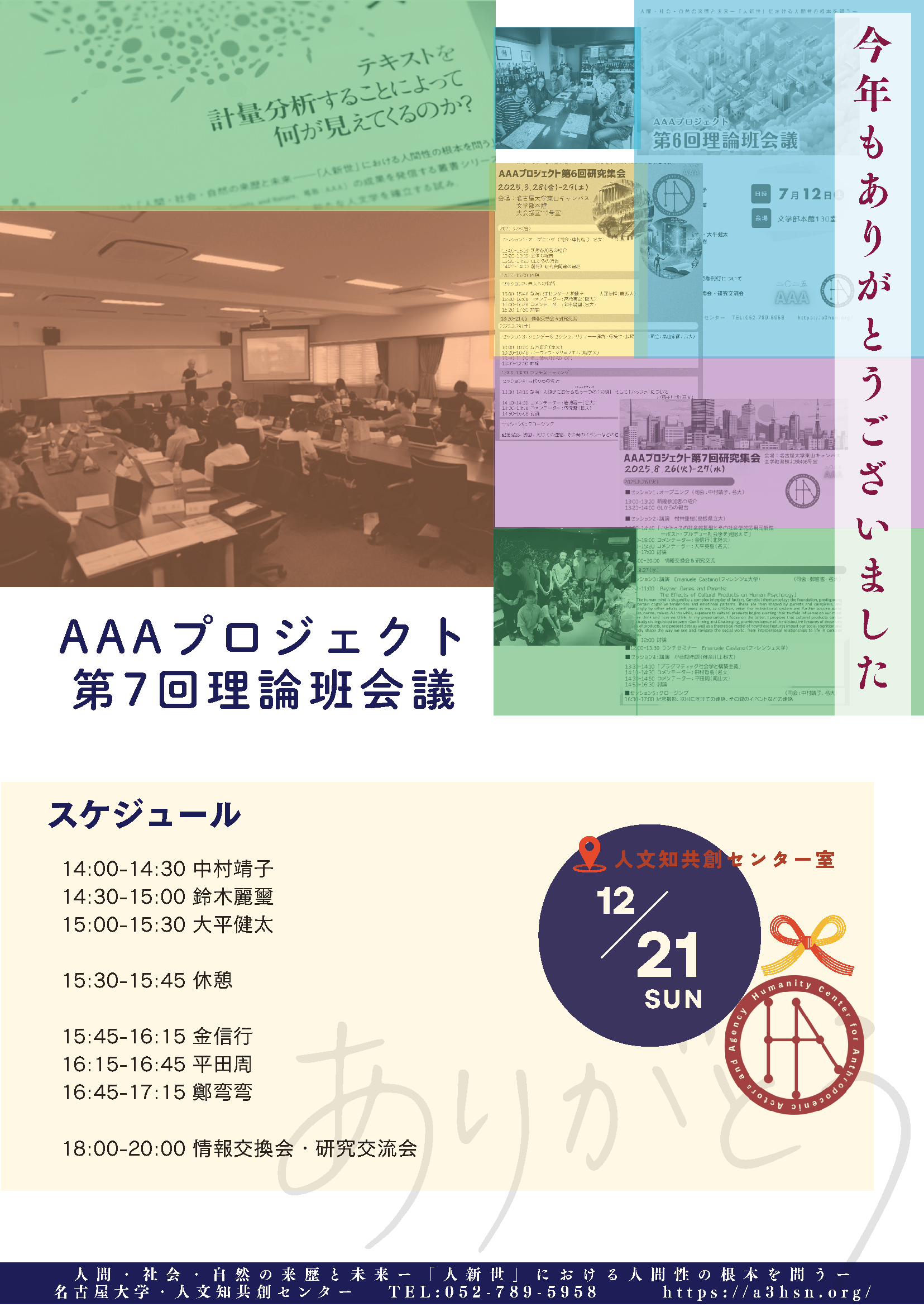
On December 21, 2025, the seventh Meeting for Theories Group was held at the Humanity Center for Anthropocenic Actors and Agency, Nagoya University.
Yasuko Nakamura focused on the role of language in human mental activity to understand Pierre Bourdieu’s (1930-2002) concept of habitus. From this perspective, she analyzed and reported on the effects of transformations in media technology on the human mind. According to Friedrich Kittler (1943-2011), the transcription systems of 1900, using media such as typewriters and phonographs, severed the feedback loop that allowed the embodiment of letters through training, making it impossible to integrate what was transcribed with the body. Based on Kittler’s media theory, Peter Sloterdijk’s (1947-) concept of “Anthropotechniken” (techniques that make humans human) and the correspondence between Sigmund Freud (1856-1939) and Lou Salomé (1861-1937) regarding the struggle between undifferentiated thought and experience and its structuring through analysis, and discussed how an integrated human personality is formed.
Reiji Suzuki reported on the research progress and challenges regarding the attempt to introduce the concept of agent-driven environmental modification into an evolutionary ecological model of language using large language models (LLMs). While conventional evolutionary ecological models of language using LLMs only dealt with competition between agents, the model introduced in this study incorporated the concept of adaptive terrain (the distribution of fitness levels of organisms relative to the environment). In this model, agents write information into their own living environments. This establishes dynamic interactions that feed back into the fitness of the next generation. The introduction of such environmental modification temporarily contributes to maintaining species diversity. However, it has become clear that ultimately, positive feedback leads to a strong tendency toward convergence. Based on these results, a future vision was presented: to model “open-ended evolution” that avoids monopolization and stagnation by specific species, instead maintaining diversity through continuous species turnover.
Kenta Ohira reported on his previous research achievements concerning the derivation of exact solutions for non-autonomous delay differential equations. In this study, by applying Fourier transforms and inverse transforms to delay differential equations containing time coefficients, he derived general solutions in the form of infinite integrals. Furthermore, by predicting the form of the solution and substituting it, he succeeded in obtaining exact solutions in the form of Gaussian infinite series, which are easier to understand than integral forms. The future challenge is to apply this method to more general delay differential equations.
Toru Ohira’s research achievements were then reported. He introduced the content of his research presentations both domestically and internationally. These included an invited lecture at KAUST in Saudi Arabia (October 24 – November 3) and a presentation at the international symposium “Risk and the International Community” (December 9) as a visiting researcher at Nagasaki University’s Global Risk Research Center. He also explained the results and concepts of his multifaceted research developments in mathematical biology, quantum mechanics, and risk research. (Reported by Professor Kenta Ohira on behalf of Toru Ohira).
Shinhaeng Kim reported on the development of Actor-Network Theory (ANT) in economic sociology, originating from Michel Callon’s (1945-2025) work. Focusing particularly on two concepts—performativity (the way in which economic knowledge and calculative devices, in the analysis of economic phenomena, actively help to constitute those very phenomena) and economization (the process by which social scientists and market actors frame and describe social phenomena as economic)—he presented a perspective that views markets as “socio-technical arrangements” where human and non-human actors are intricately entangled. From this perspective, using contemporary examples like cryptocurrencies and NFTs, he specifically discussed the divergence between developers’ idealistic assumptions and users’ practical investment practices. As a future direction, the presentation outlined a plan to investigate and analyze the gap between the ideal (decentralization) and reality (power imbalances) in blockchain’s social implementation using the ANT framework. The findings would then be fed back to the development field, aiming to foster collaborative, interventionist practices with those on the ground.
Shu Hirata first introduced Neil Brenner’s (1969) concept of “planetary urbanization,” which refers to a state where the urban domain is not confined by geographical boundaries, but rather extends across the entire planet. This includes the development of distant resources, logistics networks, and even the environmental destruction that accompanies these processes, all of which are indispensable processes for the city’s survival. In relation to this, drawing on the insights of ecologist Richard Levins, he discussed the ecological and social mechanisms by which capitalist development leads to the emergence of infectious diseases. Furthermore, based on Achille Mbembe’s (1957-) book The Earthly Community (2023), which the presenter contributed to translating, he introduced Mbembe’s thought. Mbembe proposes overcoming the limitations of traditional postcolonial theory (division through the emphasis on difference) and explains how to create a “common world” where humans and non-humans (living and non-living beings) coexist. Finally, the presentation outlined a vision for advancing the exploration of possibilities for global solidarity. This vision involves intersecting the arguments of Brenner, Levins, and Mbembe, while positioning Latour’s ANT as a crucial axis within this framework.
During the Q&A session, discussions centered on collaborative research concepts spanning various fields, centered on Actor-Network Theory. These included attempts to simulate the multi-layered interactions between actors, as indicated by Actor-Network Theory, through the multiplicity of environmental parameters in language evolution models. Hideki Ohira shared research findings on applying Kenta Ohira’s non-self-excited delayed differential equations to model interoceptive sensation involving signal transmission delays between systems.
(Authorship: Ayane Hayanagi, 1st-year Doctoral student, Graduate School of Humanities, Osaka University)