On July 1, 2023, the second Meeting for Theories Group was held in Room 128 of the Lecture Building, Faculty of Letters, Nagoya University.
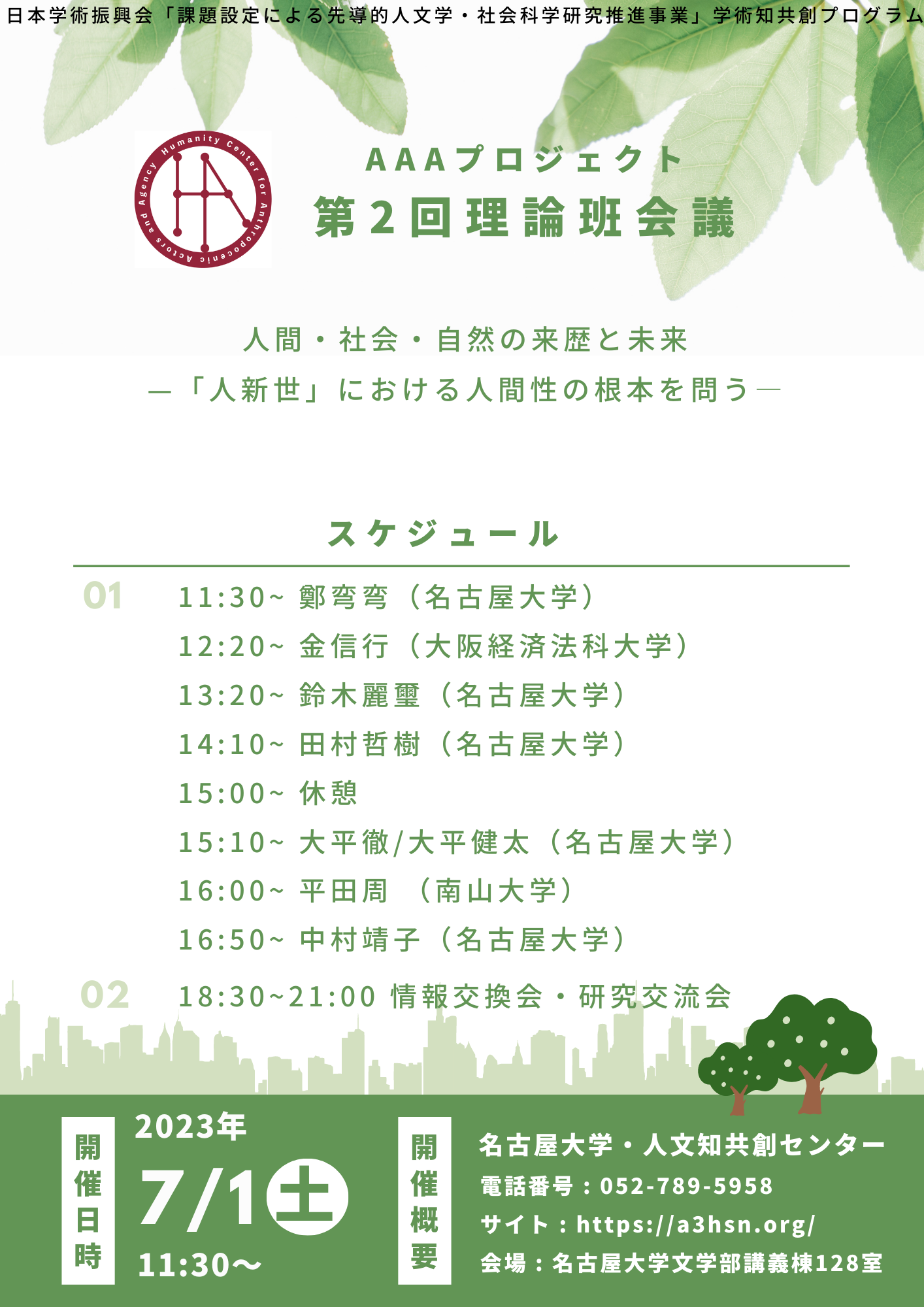
Zheng Wanwan presented on “A Label Noise Detection Method Using Shadow Data.” Against the backdrop of modern information processing devices enabling the collection of vast amounts of data across diverse fields, she introduced the latest noise detection techniques she is currently developing. She also demonstrated new possibilities for text studies brought about by the development of distributed representations in natural language processing.
Kim Shinhaeng’s presentation, titled “Early Actor-Network Theory and Text Analysis,” provided an explanation of the context of intellectual history of Mapping the Dynamics of Science and Technology, edited by researchers Michel Callon, John Law, and Arie Rip. Building on this, he explained the focal points of ANT-based qualitative text analysis in science and technology studies, as well as developments in quantitative text analysis.
Reiji Suzuki presented on “Lenia in a petri dish: Interactions between organisms and their environment in a Lenia with growth based on resource consumption,” exploring the dynamics of interactions between environment and organisms through simulation. By introducing resource channels and resource consumption/recovery dynamics into the Lenia organism’s kernel (local density accumulation function) and growth function to add environmental conditions, he demonstrated an interaction model between Lenia organisms and their resource environment based on bottom-up rules.
Tetsuki Tamura presented on “Deliberative Marriage,” outlining its concrete form as a type of “democratic marriage.” He also suggested new possibilities for the boundaries of marriage based on deliberation, contrasting with traditional conceptions of marriage. Building on feminist/gender theory perspectives on marriage, a lively discussion ensued regarding the element of “deliberation,” which has been overlooked in these frameworks.
Kenta Ohira gave a presentation titled “Delay and Resonance 2,” using differential equations incorporating self-feedback delay to describe resonance phenomena where specific rhythms (periods/frequencies) appear maximized. By adding an exponential factor to the equation proposed in his previous presentation, he demonstrated a more complex formula capable of capturing, to some extent, the behavior of solutions to delay differential equations—a task generally considered difficult.
Tohru Ohira presented “Stochastic Independence and Correlation: Classical and Quantum,” highlighting the differences between classical probability and quantum mechanics (e.g., criteria for indicating relationships between things) and similarities (e.g., the necessity of viewing the whole beyond individual instances). He presented examples where “unexpected” phenomena in classical systems, particularly in probability, become the “common sense” in quantum systems. He explored the boundary between classical and quantum systems and its development.
Shu Hirata presented on “The Epistemology of Sociology and Socialism,” introducing the research of Karsenti (1966-) who examines the transformation of philosophical inquiry through the birth of sociology. In the first half of the presentation, he provided an overview of the development of sociological epistemology in modern France from Saint-Simon (1760-1825) to Latour (1947-2022), and in the second half, he explained the redefinition of socialism (as a reaction to the excessive productivism and competition of liberalism through exclusionary nationalism, and further as socialism as a counter-reaction to both).
In her presentation titled “The Spinoza Controversy (Pantheism Controversy),” Based on Yasushi Kato’s Spinoza and Modern Germany: The Phantom Axis of Intellectual History (Iwanami Shoten, 2022), Yasuko Nakamura traced the enormous influence that Spinoza’s philosophy, which was considered dangerous as atheistic, had on the intellectual history of modern Germany, while also introducing the history of opposition to and acceptance with Spinoza’s pantheism.
Following each presentation, lively discussions took place during the Q&A sessions, exploring the connections between the respective research themes and the potential for interdisciplinary development across different fields.
(Authorship: Ayane Hayanagi, 1st-year Master’s student, Graduate School of Humanities, Osaka University)