On December 27, 2023, the third Meeting for Theories Group was held at the Humanity Center for Anthropocenic Actors and Agency, Nagoya University.
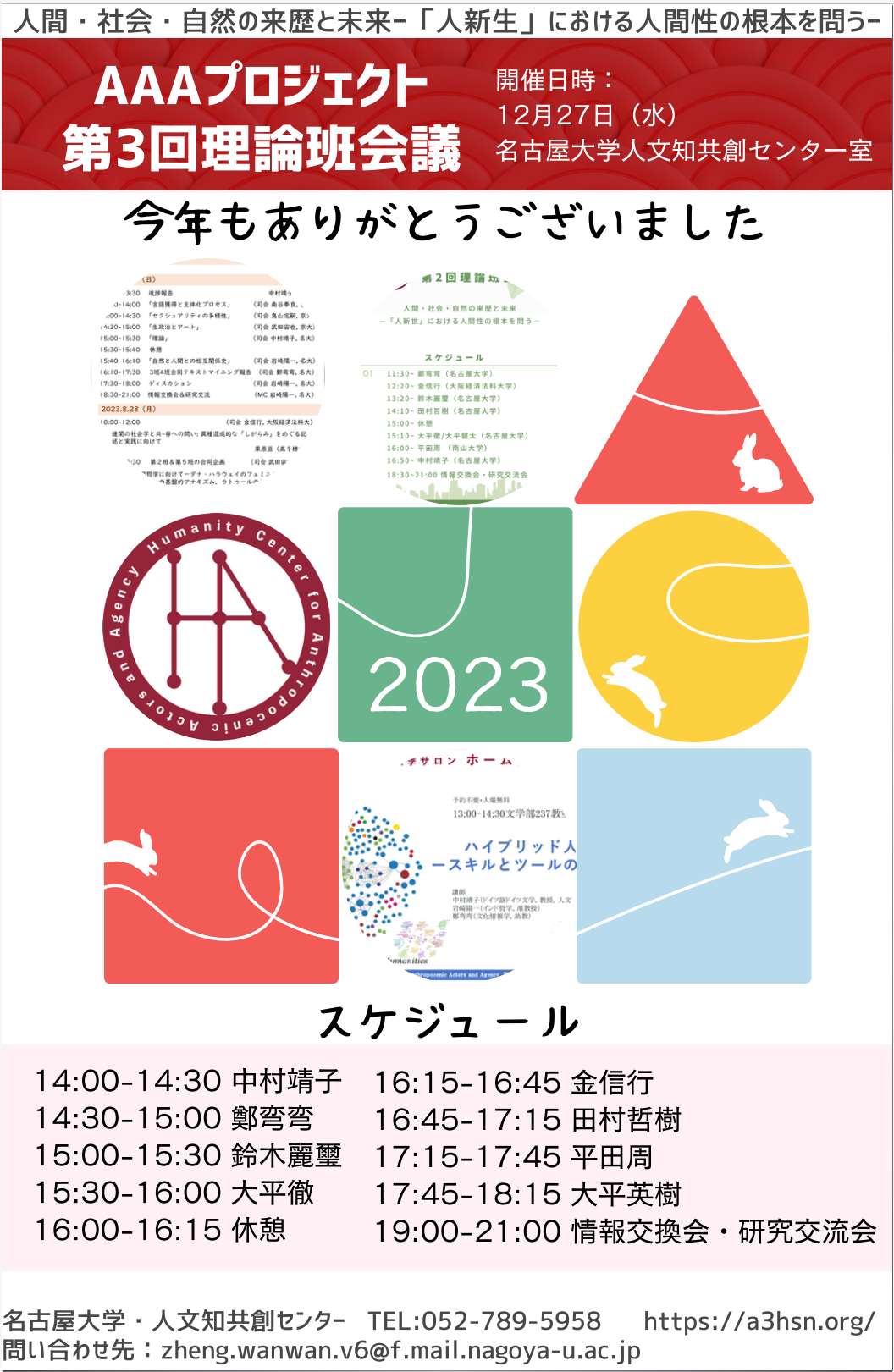
Yasuko Nakamura introduced a practical application of sentiment analysis to the original German text of Rainer Maria Rilke’s novel The Notebooks of Malte Laurids Brigge. Through this case, she demonstrated the potential of sentiment analysis as a method for the study of literary works. She also reported on the plans and current progress of a collaborative research project with Professor Zheng, which further develops this research.
Wanwan Zheng presented her research framework, proposing a new model for feature selection that extracts effective variables for data analysis, with the aim of improving both interpretability and practical applicability. She also outlined the construction of a new indicator for measuring lexical richness, which integrates three dimensions: lexical diversity, lexical density (the proportion of content words), and lexical sophistication (the use of advanced vocabulary). In addition, as a practical application of sentiment analysis, she reported on a study comparing official sentiment scores on economic conditions (based on human evaluations) with sentiment scores generated by existing large language models as well as by a newly developed model.
Reiji Suzuki reported on a practice that quantified the degree of positivity and negativity in social media posts during the Japan Series between the Hanshin Tigers and Orix Buffaloes using sentiment analysis, and further made it audible through music generation using ChatGPT and MusicGen. Additionally, presentations addressed approaches that incorporate complex, higher-order characteristics—such as personality and preferences underlying human behavior, which are difficult to directly model mathematically—by linking natural language expressions to behavioral strategies using large language models. Other presentations explored attempts to utilize generative models for expressing cultural traits and their evolution.
Kenta Ohira and Toru Ohira proposed a delayed differential equation to express the resonance phenomenon arising from delayed self-feedback and introduced the behavior of its solutions. Furthermore, using the Lotka-Volterra equations representing a predator-prey model as an example, they demonstrated that periodic fluctuations in the populations of predators (lynx) and prey (hare) occur even without a clock function. They then introduced time and delay into this system to attempt to express the interaction between the two species.
Shinhaeng Kim introduced H. Mialet’s paper “Hawking Inc.,” which analyzes the knowledge production process centered on British theoretical physicist Stephen Hawking. By identifying the actors involved in knowledge production, he examined the role of humans—a question posed by AI technology—and discussed how ANT could play a role within STS, which has relativized the process of knowledge production in science.
Tetsuki Tamura discussed the possibilities of how democracy can continue to be ‘democracy’ in the information society. He introduced the concept of AI democracy, accepting critiques regarding the dangers of authoritarianism and tendencies toward human exclusion. Focusing on three elements—inclusivity, representation, and decisiveness—he analyzed its democratic and non-democratic characteristics.
Shu Hirata focused on the establishment of the term “emotion” as a scientific concept in contrast to ‘passion’ as a theological concept, and analyzed the interactive development between the concept of emotion and society. He also reported on trends in contemporary French research on emotion, and introduced Achille Mbembe’s paper “La communauté terrestre,” which explores the relationship between humans and the Earth from the perspective of African animism.
At the third meeting, it was confirmed that research had progressed by further strengthening collaboration across different field based on the insights shared at the second meeting. During the Q&A sessions following each presentation, discussions focused on more concrete and active plans for collaborative research.
(Authorship: Ayane Hayanagi, 1st-year Master’s student, Graduate School of Humanities, Osaka University)