On December 7, 2024, the fifth Meeting for Theories Group was held in Room 402 of the Main Building, Faculty of Letters, Nagoya University.
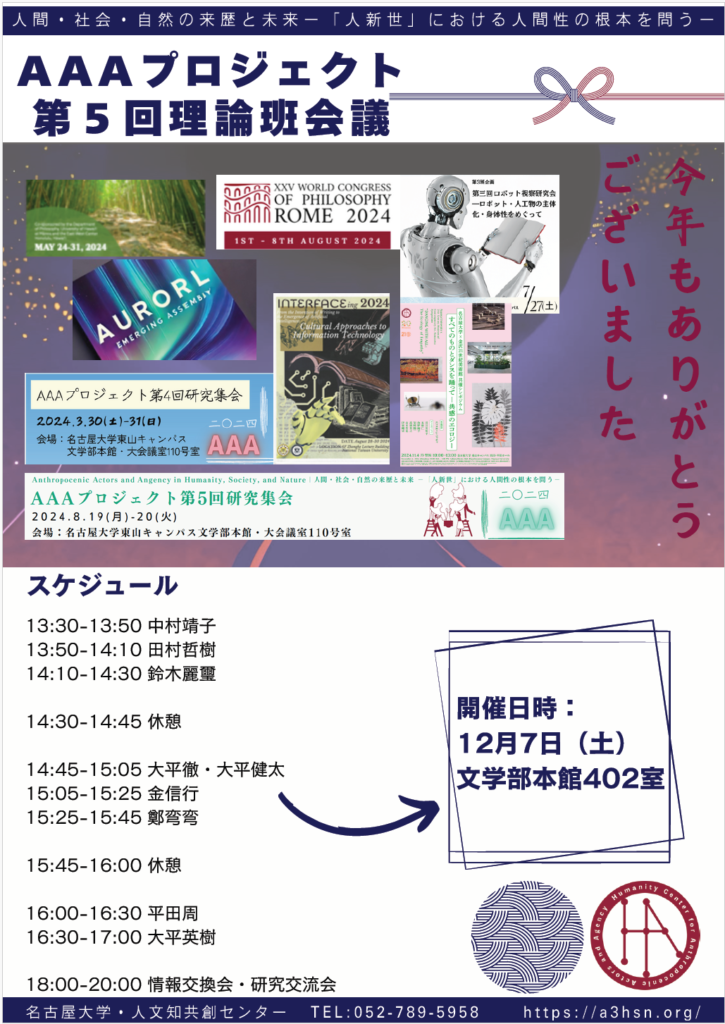
Yasuko Nakamura presented “Freud’s Text Analysis,” structured in three parts: an activity report, future plans, and a research progress report. The progress report shared the increase in the number of documents included in the corpus and the accompanying progress in data processing, new discoveries using structural topic models enabled by data expansion, and attempts at lexical interpretation through topic analysis.
During the Q&A session, there were comments regarding comparisons with other thinkers who showed changes between the early and late periods. Discussions were held on the selection of comparison subjects and the validity of the analysis methods, and approaches for future research were considered.
Tetsuki Tamura delivered a presentation titled “How is ‘Politics’ Possible in a Post-Anthropocentric World?” exploring the potential for “post-anthropocentric politics” based on Actor-Network Theory (ANT). This presentation explored the possibility of a new framework that does not limit ‘politics’ to an anthropocentric framework but incorporates relationships with things and non-humans.
During the Q&A session, discussions covered whether objects and non-humans could function as agents in politics, how legitimacy and responsibility might be distributed in a “politics” that includes these elements, and whether objects and non-humans could make an essential contribution to ‘politics.’
Reiji Suzuki first explained the concept of niche construction in the social particle swarm model. To observe the effects of environmental modification through interactions and its accumulation on the behavior of social groups, two key elements were introduced: the cultural niche and the fluid niche. He then presented an integrated analysis of the Prisoner’s Dilemma and the stag hunt game, and an attempt to extract behavioral tendencies from personality trait descriptions.
During the Q&A session, discussions covered the concept of niche construction, the construction of the agent itself, whether agent behavior is optimized, the impact of niche construction on long-term cooperation formation, and its interactions with other environmental factors.
Kenta Ohira reported on this year’s publication and academic conference activities, and presented the latest research progress on finding solutions to delayed differential equations. This research introduced new methods and analytical results for solving delayed differential equations, and presented future prospects.
Toru Ohira explained the dynamics of pattern formation in animal epidermis. He provided a detailed explanation of how factors such as growth, seasonality, and body temperature influence the emergence and fading of patterns, and visualized the dynamics of pattern formation using simulations.
During the Q&A session, lively discussions took place regarding the parameter settings and their criteria in Kenta Ohira’s research on delayed differential equations, as well as the potential applications of biological pattern formation presented by Toru Ohira to other fields.
Shinhaeng Kim reported on the smooth social implementation of Actor–Network Theory (ANT) and blockchain (BC) in his presentation, “Actor–Network Theory and Blockchain.” The report introduced an analytical method using Koray Çalışkan’s DARN (Actors, Networks, Devices, Representations) approach. It presented a concrete example (gun crime) and demonstrated the potential for understanding complex social phenomena as a collection of distributed actions.
During the Q&A session, discussions covered examples of BC utilization and its societal significance, BC systems without human intervention, and the roles and influence of actors in BC implementation.
Wanwan Zheng presented “Sentiment Analysis: Bias in Human Emotion Judgment,” addressing the primary challenge of “data subjectivity” in sentiment analysis. To address this issue, she focused on extracting more reliable data and building sentiment analysis models based on it. She demonstrated methods to overcome subjectivity in sentiment labeling and potential for further improvement of sentiment analysis models.
Shu Hirata presented on “Animism, Gaia, and Multispecies,” explaining the concept of animism and its contemporary significance. Bruno Latour’s vision of the non-modern was cited as the philosophical foundation of animism, emphasizing the hybrydity of nature and society. The presentation also redefined the city as a space “not only for humans” and proposed that coexistence with other species should be taken into account in urban design.
During the Q&A session, lively discussions took place on issues such as the general conception of modernity and the separation of nature and society based on it, the relationship and interactions between humans and non-human actors, and the hybridity of nature and society.
Hideki Ohira presented titled “Neural Habitus: Mechanisms of the Brain and Body Generating, Maintaining, and Transforming Habitus,” reexamining Pierre Bourdieu’s concept of “habitus” from a neuroscientific perspective. From the view of the brain as a “predictive machine,” the presentation provided a detailed explanation of how discrepancies between predictions based on internal models and actual inputs—so-called prediction errors—govern behavior and perception. Additionally, the role of prediction error in the emergence of emotions and decision-making was discussed using concepts such as the coordination between emotions and the body and processing fluency.
(Authorship: Wanwan Zheng, Humanity Center for Anthropocenic Actors and Agency